How Alcohol Content (ABV) Affects a Drink’s Calories
How ABV Affects Calorie Count
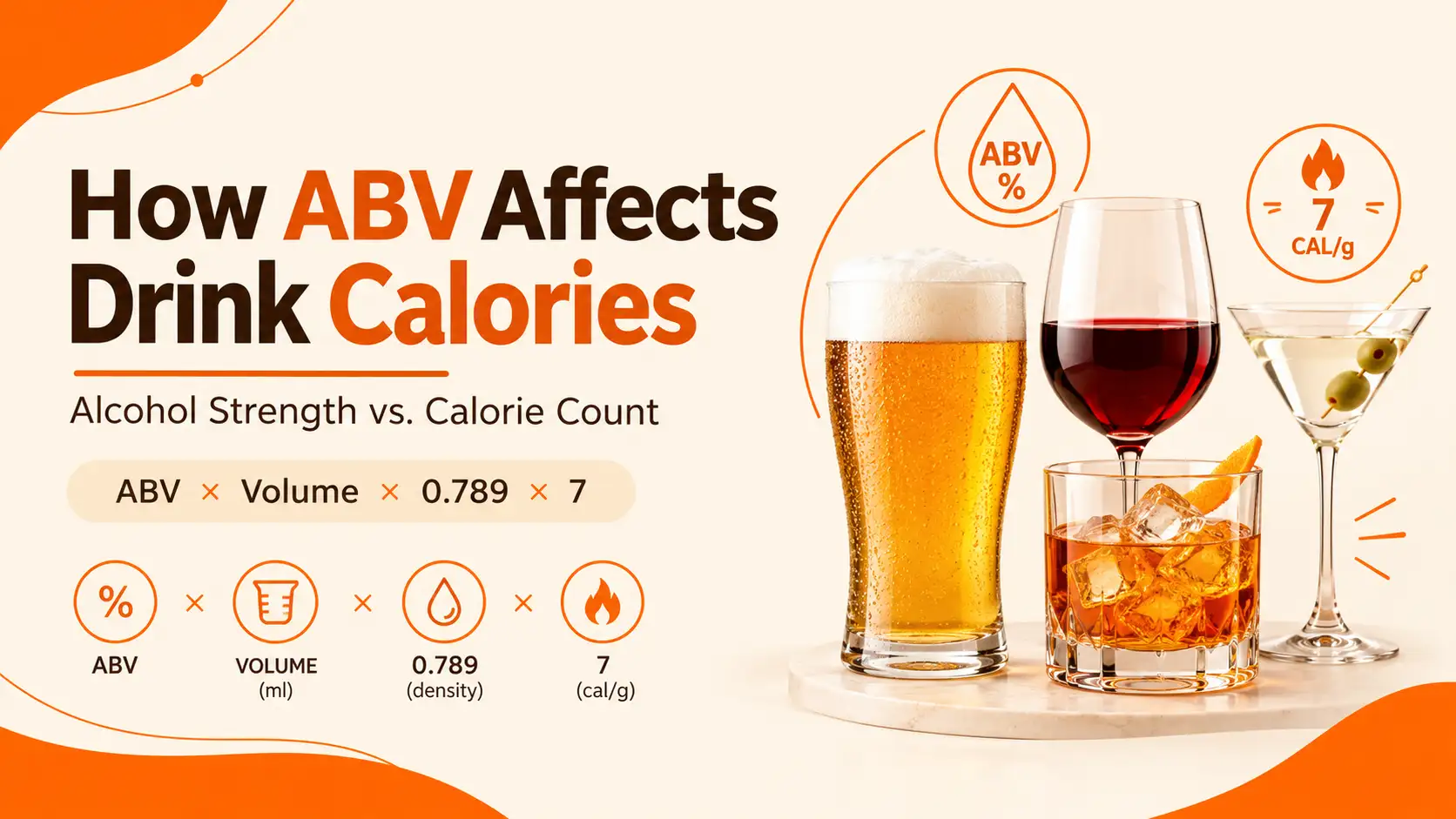
The higher a drink’s ABV, the more calories it packs from alcohol alone. That’s because pure alcohol carries 7 calories per gram no matter what you’re drinking, so a stronger pour always means more calories on that front, even before you factor in anything else in the glass.
It’s a simple relationship once you see it laid out, but most people never actually think about it this way. They’ll compare a beer to a cocktail based on how “heavy” it feels, or how sweet it tastes, and miss the part that’s doing the real work: the alcohol percentage itself. A 4% light beer and an 8% craft IPA aren’t just different in flavor. One of them is quietly carrying twice the alcohol calories of the other, and that adds up fast if you’re having more than one.
Why Alcohol Calories Are Called “Empty Calories”
Alcohol supplies energy but almost nothing else. No protein, no fiber, barely any vitamins or minerals. That’s the whole reason nutritionists call it “empty calories,” it fills your daily total without giving your body anything useful in return.
There’s a metabolic wrinkle here too, and it’s one people rarely hear about. Your body treats alcohol almost like a priority guest. It processes alcohol before it gets around to other nutrients, which means dietary fat sitting in your system at the same time is more likely to get stored rather than burned. So it’s not just that alcohol calories are empty, it’s that they can quietly nudge how your body handles everything else you’ve eaten that day. That’s worth knowing if you’re keeping an eye on weight, even if you’re not counting every single calorie obsessively.
The Formula: Calculating Calories from ABV
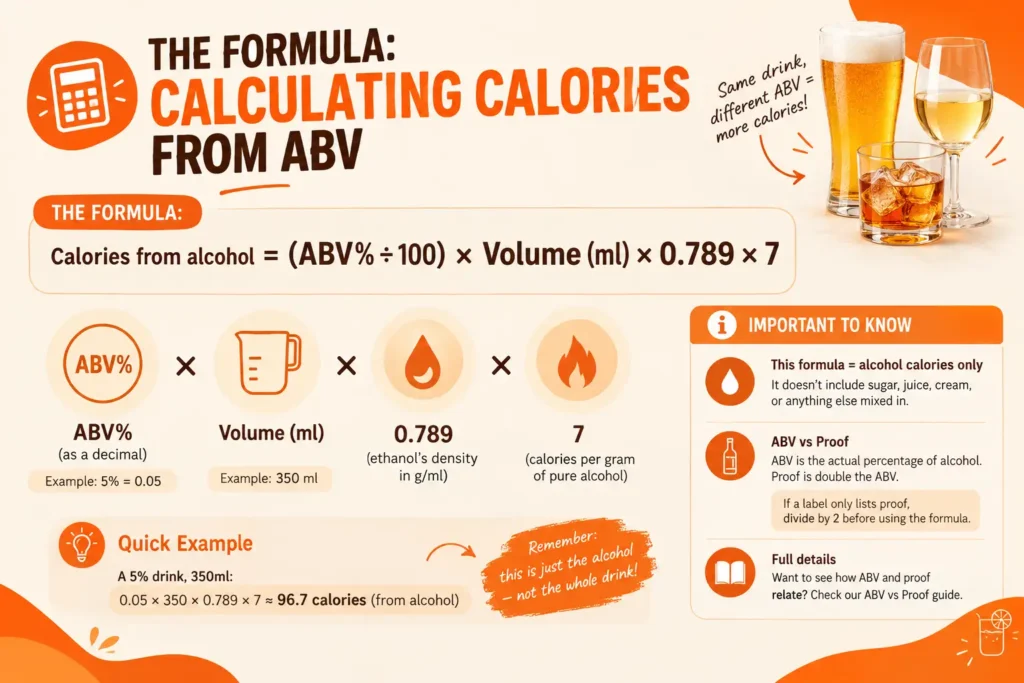
Calories from alcohol = (ABV% ÷ 100) × Volume (ml) × 0.789 × 7
This formula comes from the USDA Atwater factor, which sets pure alcohol at 7 calories per gram. The 0.789 is ethanol’s density in grams per milliliter, basically the number you need to convert a volume of alcohol into a weight, since calories are measured per gram, not per milliliter. Multiply that weight by 7, and you’ve got your alcohol-derived calorie count.
Worth saying plainly: this only tells you the calories coming from the alcohol itself. It doesn’t touch sugar, juice, cream, or anything else mixed in. We’ll get to that.
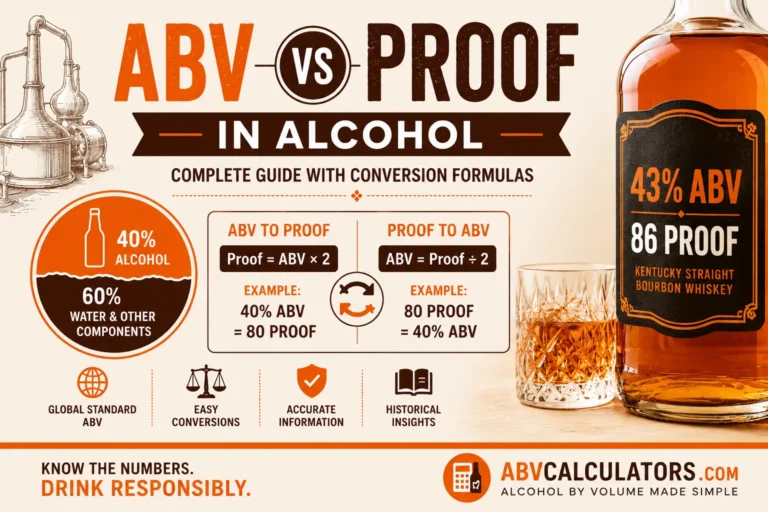
A quick note on proof, since the two terms get mixed up constantly. ABV is the actual percentage of alcohol in a drink. Proof is just ABV doubled, a holdover from an old measurement system, so a 40% ABV vodka is 80 proof. The calorie formula always uses ABV, not proof, so if a label only lists proof, divide by two before you plug the number in. If you want the full breakdown of how these two relate, that’s covered separately in our ABV vs Proof guide.
Worked Example: Two Drinks, Same Volume, Different ABV
Let’s put real numbers on it. Say you’ve got two 350ml drinks, a 5% beer and a 12% glass of wine.
Beer (5% ABV, 350ml):
0.05 × 350 × 0.789 × 7 ≈ 96.7 calories from alcohol
Wine (12% ABV, 350ml):
0.12 × 350 × 0.789 × 7 ≈ 232 calories from alcohol
Same volume, same glass size even, but the wine comes in at more than double the alcohol calories. Nothing about the ingredients changed here. It’s the ABV doing all the heavy lifting.
Ethanol Calories vs. Mixer Calories in Cocktails
Here’s where it gets more complicated, and honestly, where most people get tripped up. A cocktail’s total calorie count isn’t just its ABV run through that formula. It’s alcohol calories plus whatever else got poured, muddled, or blended in.
Take a rum and Coke versus a rum and diet Coke. Same spirit, same ABV, same pour. But the regular Coke adds a second layer of sugar calories on top of the alcohol calories, while the diet version doesn’t. That’s the whole difference between a roughly 185-calorie drink and one closer to 100. The ABV formula above only ever gets you halfway to the real total for a mixed drink. You still need to account for the mixer separately.
Calories by Drink Strength
This table compares alcohol-only calories across a range of ABV values, all at a fixed 350ml serving size, so you can see the effect of ABV in isolation.
ABV
4%
5%
8%
12%
15%
40% (spirit, smaller pour typically used)
Calories from Alcohol (350ml)
77
97
155
232
290
773 (per 350ml, for reference only)
Note that nobody drinks 350ml of a 40% spirit in one go, that row is there purely to show how steep the curve gets, not as a real serving suggestion.
Common Mistakes When Calculating Alcohol Calories
A few things trip people up nearly every time, and they’re easy to fix once you know to watch for them.
Use This With the Cocktail ABV Calculator
If you don’t already know your drink’s ABV, that’s the number you need first before any of this math works. Run your ingredients through the Cocktail ABV Calculator to get an accurate ABV reading, then plug that number into the formula above to estimate your alcohol-derived calories. It’s a two-step process, but each step only takes a minute.
Frequently Asked Questions (FAQs)
Conclusion
ABV isn’t just a number on a label, it’s the biggest single factor in how many calories your drink actually carries. A stronger pour always means more alcohol calories, full stop. What changes the picture is everything else in the glass, the mixer, the sugar, the cream, and that part you have to calculate separately every time.
If you’re trying to actually manage this rather than just guess, find your drink’s ABV using the Cocktail ABV Calculator, run that number through the formula above, then add in whatever the mixer’s contributing. Two minutes of math, and you’ll know a lot more about what’s actually in your glass than most people ever bother to figure out.