
If you have ever brewed from a European recipe or used a commercial brewing system, you have probably run into Degrees Plato and wondered how it lines up with the specific gravity numbers you are used to. A home brew alcohol content calculator can take that converted SG value straight through to a final ABV result. This calculator converts Plato to SG and SG back to Plato instantly. Below the calculator, you will find the full conversion chart, the formulas behind the numbers, and what those Plato readings actually mean for your beer.
What Is Degrees Plato and Where Did It Come From?
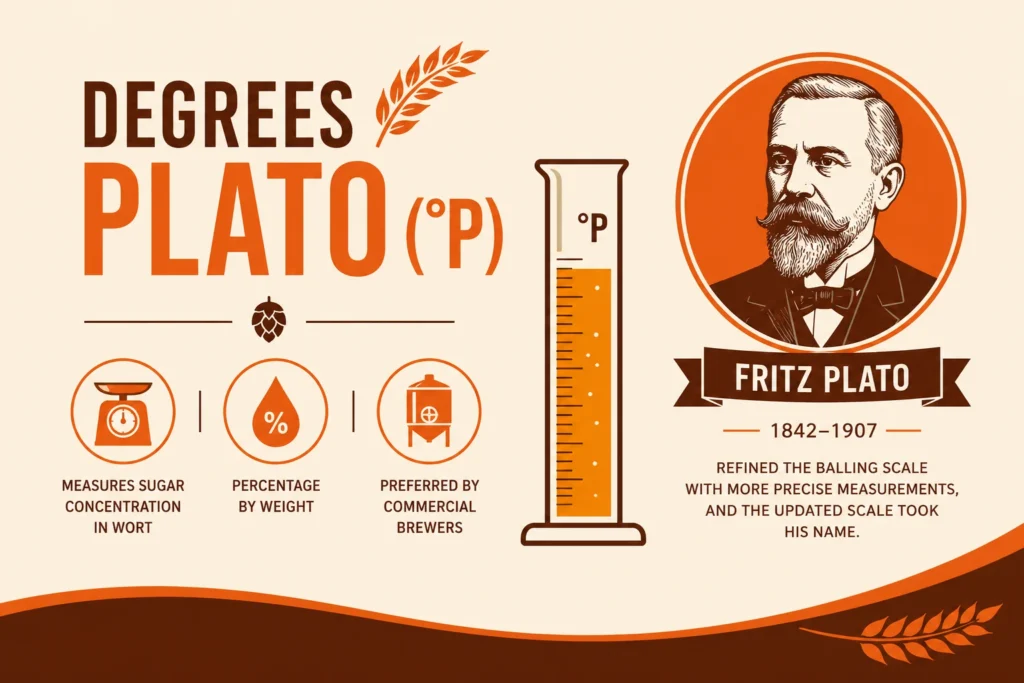
Degrees Plato (°P) is a unit that tells you the sugar concentration in wort as a percentage by weight. A reading of 12°P means that 12 grams out of every 100 grams of wort is dissolved sugar.
The scale is named after Fritz Plato, a German scientist who refined an earlier measurement system in the late 19th century. Before Plato, brewers used the Balling scale, developed by Karl Balling in the 1840s. Fritz Plato and his team at the German Imperial Normal Aichungs Commission revised Balling’s work with more precise measurements, and the updated scale took his name.
Continental European breweries adopted Degrees Plato as their standard. It gave brewers a direct read on sugar content rather than a density comparison to water. That directness is why commercial brewers still prefer it today.

Plato vs Specific Gravity: What Is the Difference?
Both measurements describe how much sugar is dissolved in your wort. They just express it differently.
Plato to SG Formula, Simple vs Precise
There are two ways to convert Plato to SG. Which one you use depends on how much accuracy you need.
Quick Approximation Formula
For fast field estimates, multiply Plato by 0.004 and add 1.000.
SG = 1.000 + (°P × 0.004)
Example: 15°P × 0.004 = 0.060, so SG = 1.060
This works well enough for rough calculations and quick mental math. At lower Plato values, it is reasonably accurate. As you get into higher gravity territory above 20°P, the approximation starts to drift from the true value.
Precise Polynomial Formula
For accurate brewing calculations, the industry standard formula is:
SG = 1 + (°P / (258.6 − ((°P / 258.2) × 227.1)))
The constants 258.6, 258.2, and 227.1 come from empirical brewing research that mapped the relationship between sugar concentration and liquid density across a wide range of wort samples. This nonlinear formula captures the curve in that relationship that the simple approximation misses.
Example: 15°P using the polynomial formula gives SG = 1.0611, while the quick formula gives 1.060. At lower Plato values, the difference is small. At 25°P the quick formula gives 1.100 while the polynomial gives 1.1057. The gap widens at higher gravities, which matters for high-gravity brewing.
SG to Plato Formula
To convert in the other direction, from SG to Plato, the formula is:
°P = 135.997 × SG³ − 630.272 × SG² + 1111.14 × SG − 616.868
Example: SG 1.048 °P = 135.997(1.048³) − 630.272(1.048²) + 1111.14(1.048) − 616.868 = 11.9°P
An alternative formula used by some calculators: °P = (−463.37) + (668.72 × SG) − (205.35 × SG²)
Both formulas give results that are close enough for brewing purposes. The first (cubic polynomial) is the more widely cited standard.
Complete Plato to SG Conversion Chart (0.5°P to 40°P)
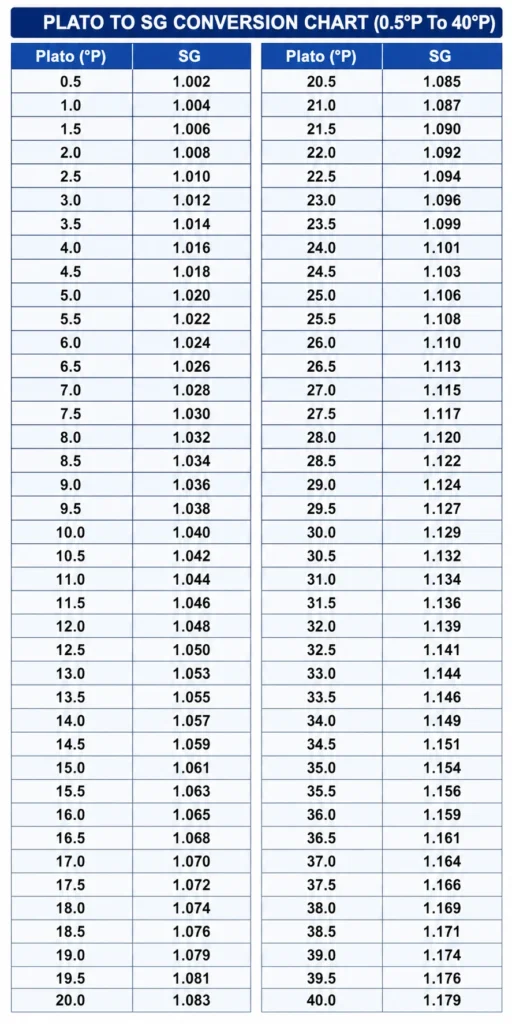
| Plato (°P) | SG |
| 0.5 | 1.002 |
| 1.0 | 1.004 |
| 1.5 | 1.006 |
| 2.0 | 1.008 |
| 2.5 | 1.010 |
| 3.0 | 1.012 |
| 3.5 | 1.014 |
| 4.0 | 1.016 |
| 4.5 | 1.018 |
| 5.0 | 1.020 |
| 5.5 | 1.022 |
| 6.0 | 1.024 |
| 6.5 | 1.026 |
| 7.0 | 1.028 |
| 7.5 | 1.030 |
| 8.0 | 1.032 |
| 8.5 | 1.034 |
| 9.0 | 1.036 |
| 9.5 | 1.038 |
| 10.0 | 1.040 |
| 10.5 | 1.042 |
| 11.0 | 1.044 |
| 11.5 | 1.046 |
| 12.0 | 1.048 |
| 12.5 | 1.050 |
| 13.0 | 1.053 |
| 13.5 | 1.055 |
| 14.0 | 1.057 |
| 14.5 | 1.059 |
| 15.0 | 1.061 |
| 15.5 | 1.063 |
| 16.0 | 1.065 |
| 16.5 | 1.068 |
| 17.0 | 1.070 |
| 17.5 | 1.072 |
| 18.0 | 1.074 |
| 18.5 | 1.076 |
| 19.0 | 1.079 |
| 19.5 | 1.081 |
| 20.0 | 1.083 |
| 20.5 | 1.085 |
| 21.0 | 1.087 |
| 21.5 | 1.090 |
| 22.0 | 1.092 |
| 22.5 | 1.094 |
| 23.0 | 1.096 |
| 23.5 | 1.099 |
| 24.0 | 1.101 |
| 24.5 | 1.103 |
| 25.0 | 1.108 |
| 25.5 | 1.106 |
| 26.0 | 1.108 |
| 26.5 | 1.113 |
| 27.0 | 1.115 |
| 27.5 | 1.117 |
| 28.0 | 1.120 |
| 28.5 | 1.122 |
| 29.0 | 1.124 |
| 29.5 | 1.127 |
| 30.0 | 1.129 |
| 30.5 | 1.132 |
| 31.0 | 1.134 |
| 31.5 | 1.136 |
| 32.0 | 1.139 |
| 32.5 | 1.141 |
| 33.0 | 1.144 |
| 33.5 | 1.146 |
| 34.0 | 1.149 |
| 34.5 | 1.151 |
| 35.0 | 1.154 |
| 35.5 | 1.156 |
| 36.0 | 1.159 |
| 36.5 | 1.161 |
| 37.0 | 1.164 |
| 37.5 | 1.166 |
| 38.0 | 1.169 |
| 38.5 | 1.171 |
| 39.0 | 1.174 |
| 39.5 | 1.176 |
| 40.0 | 1.179 |
Specific Plato Values Explained in Context
The conversion chart gives you numbers. This section tells you what those numbers mean for actual beer.

7°P to SG (1.028)
A wort at 7°P is a light, low-gravity wort. It sits at the starting point for session beers and light lagers. German Schankbier and some traditional British milds are brewed in this range. The low sugar content means the finished beer will be well below 4% ABV. At 7°P you are not building a strong beer. You are building something drinkable, low in alcohol, and easy on the palate.
10°P to SG (1.040)
10°P is the entry point for what most people picture when they think of standard everyday beer. American lagers, light ales, and session IPAs often start here. The finished beer typically comes in around 4 to 4.5% ABV, assuming normal attenuation. Most commercial light beers are brewed at or just below this Plato value.
12°P to SG (1.048)
12°P is where a lot of the world’s most popular beers sit. German Helles, Czech Pilsner, and many English pale ales are designed around this original gravity. The Czechs actually call this strength “dvanáctka“, the twelve, and it represents the standard strength reference point in Czech brewing culture. At 12°P you are looking at roughly 5% ABV in the finished beer.
13°P to SG (1.053)
13°P sits between standard and full-bodied. American craft pale ales, amber ales, and many session IPAs target this range. It gives the brewer enough malt backbone to support hop additions without pushing into strong beer territory. Finished ABV typically lands around 5.5 to 6%.
15°P to SG (1.061)
15°P marks the start of what most brewing systems classify as a stronger beer. American IPAs, German Export lagers, and many Belgian ales are brewed at this gravity. At 15°P with good attenuation, the finished beer reaches roughly 6.5 to 7% ABV. This is also the Plato range where recipe precision starts to matter more because small measurement errors have a larger effect on the final alcohol content.
20°P to SG (1.083)
This is where high-gravity brewing begins. Double IPAs, Belgian Tripels, and strong ales are brewed in this range, finishing around 10 to 11% ABV with full attenuation. This is also the point where the quick approximation formula loses accuracy. At 20°P, the quick formula gives1.080 while the polynomial gives 1.083. From here upward, the polynomial formula is the one to use.
Beer Styles and Their Typical Plato Range
Every beer style has an expected original gravity range. Knowing where a style sits in Plato terms helps when reading European recipes, ordering malt, or comparing your readings against style guidelines.
Beer Style
Light lager
American lager
Czech Pilsner (dvanáctka)
German Helles
Pale ale/session IPA
American IPA
German Export
Belgian Tripel
Imperial Stout
Barleywine
Typical OG Range (°P)
7 to 9°P
10 to 11°P
12°P
11 to 12°P
12 to 14°P
14 to 17°P
13 to 14°P
18 to 22°P
22 to 28°P
25 to 30°P
Typical SG Range
1.028 to 1.036
1.040 to 1.044
1.048
1.044 to 1.048
1.048 to 1.057
1.057 to 1.070
1.053 to 1.057
1.074 to 1.092
1.092 to 1.120
1.106 to 1.130
Approx ABV
3.2 to 4%
4 to 4.5%
4.8 to 5.2%
4.5 to 5%
4.5 to 5.5%
6 to 7.5%
5 to 5.5%
8 to 10%
10 to 13%
11 to 14%
High-gravity brewing above 20°P brings extra challenges. Yeast stress increases at higher sugar concentrations, and the simple approximation formula becomes less reliable. The polynomial formula and precise measurement tools matter more at these gravity levels.
Why Commercial Brewers Use Plato Over SG
Walk into any commercial brewery in Germany, the Czech Republic, or Belgium, and you will not hear anyone talking about 1.048 gravity. They say 12 Plato. The reasons go back further than most people realize, and they are practical, not just traditional.
Commercial brewers prefer Plato because it gives them direct, actionable numbers at every stage of production:
A brewer who works only in SG and converts to Plato only when required is adding unnecessary steps and potential for error into a process where precision matters. That is why most commercial brewing software, including BeerSmith and ProMash, supports both units, but European and international operations default to Plato as the working standard.
Plato vs Brix vs Balling: Are They the Same?
You will run into all three of these scales in brewing and winemaking, and the relationship between them confuses a lot of people.
Balling | Balling came first. Karl Balling developed it in the 1840s as a way to measure dissolved sugar in solution. It was the first standardized sugar measurement scale widely used in brewing. |
Plato | Plato is a refined version of Balling. Fritz Plato and his team corrected errors in Balling’s tables using more precise measurement methods. The values are very close but not identical. At common brewing concentrations, the difference is less than 0.1 degrees. |
Brix | Brix is the modern international standard used in winemaking, food science, and agriculture. It measures the same thing as Plato but was developed independently through a slightly different methodology. |
At the sugar concentrations you encounter in brewing and winemaking, roughly 8°P to 26°P, the three scales agree to within 0.1 degrees. For homebrew purposes, treating them as interchangeable introduces negligible error. If your equipment reads in Brix instead of Plato, a brix conversion calculator handles the same math without manual lookup. For laboratory-grade precision work, the differences matter, and calibrated equipment specific to each scale should be used.
The practical takeaway: if a winemaker says 22 Brix and a brewer says 22 Plato, they are measuring essentially the same sugar concentration.
How to Calculate ABV from Plato
This is where Plato becomes more than just a conversational curiosity. If your brewing system gives you gravity readings in Plato rather than SG, you can calculate ABV directly from those Plato readings without converting to SG first.
Original Plato and Final Plato
Just like SG-based brewing uses Original Gravity (OG) and Final Gravity (FG), Plato-based brewing uses Original Plato (OG°P) and Final Plato (FG°P).
Original Plato is the sugar concentration of the wort before fermentation begins. Final Plato is the reading taken after fermentation is complete, when yeast has consumed most of the fermentable sugars.
The drop from Original Plato to Final Plato represents how much sugar was consumed. Most well-attenuated ales finish at 2 to 3°P. Lagers and highly attenuated styles can finish below 2°P.
Plato to ABV Formula
The standard formula used by commercial brewers to calculate ABV from Plato readings is:
ABV = (OG°P − FG°P) × 0.59 / (1 − (FG°P / 258.6))
For most practical purposes, a simpler approximation works well:
ABV ≈ (OG°P − FG°P) × 0.6
Example: OG = 12°P, FG = 2.5°P ABV ≈ (12 − 2.5) × 0.6 = 9.5 × 0.6 = 5.7% ABV
The 0.6 factor accounts for the relationship between sugar consumption and ethanol production. It is less accurate at extreme gravities but reliable across the normal brewing range of 8°P to 20°P original gravity.
For higher accuracy, convert your Plato readings to SG using the polynomial formula and then use the standard SG-based ABV calculation.
Temperature Compensation in Plato and SG Readings
Brewers sometimes adjust alcohol content. Every gravity reading, whether in Plato or SG, is only accurate when taken at the right temperature. Hydrometers are calibrated at a standard temperature, typically 20°C (68°F). Refractometers have their own calibration standard.
When your wort sample is warmer than the calibration temperature, it is less dense than it would be at the standard temperature. The hydrometer sits higher than it should, giving you a falsely low reading. When the sample is cooler, the opposite happens.
Temperature variation of just 5 to 10°F can shift a hydrometer reading by 0.001 to 0.002 SG units. In Plato’s terms, that can mean a difference of 0.25 to 0.5°P. For a recipe targeting 12°P exactly, that is a meaningful error.
The correction works like this: Corrected SG = Measured SG + (0.000132 × (T − Tcal))
Where T is your sample temperature, and Tcal is the hydrometer’s calibration temperature.
Most digital refractometers include automatic temperature compensation (ATC) for readings at room temperature. For wort samples taken directly from a hot kettle, letting the sample cool in a tube before measuring gives a more accurate result than applying a correction factor manually.
Post-Fermentation Plato Readings: Why Alcohol Changes Everything?
Here is something that catches a lot of brewers off guard. A refractometer reads Plato or Brix by measuring how light bends through the liquid. Before fermentation, the only dissolved substance bending that light is sugar. After fermentation begins, alcohol is also present, and alcohol bends light differently than sugar does.
This means a refractometer reading taken from fermenting or fermented beer is no longer an accurate measure of sugar concentration. The alcohol in the solution pulls the reading down, making it appear that more sugar has been consumed than actually has.
If you take a refractometer reading mid-fermentation and use it as your Final Plato without correction, your calculated ABV will be wrong. The correction formula for post-fermentation refractometer readings in Plato:
Corrected FG°P = 1.0000 − 0.0044993 × (OG°P) + 0.011774 × (Apparent FG°P)
For final gravity confirmation after fermentation, a hydrometer remains the most reliable tool. It measures density directly and is not affected by alcohol interference in the same way a refractometer is.

Plato in Regulatory and Commercial Brewing
Plato is not just a measurement preference in commercial brewing. In many countries, it carries legal weight.
In Germany, the Stammwürze printed on a beer label is the original wort concentration in Plato. This number is used to calculate the tax owed on the beer at production. German beer law ties the Stammwürze to the beer’s character and style classification. A beer labeled as a 12°P Pilsner must actually have been brewed from a 12°P wort.
In the United States, the TTB requires breweries to document original gravity for excise tax purposes. While TTB documentation typically uses SG, many larger American craft breweries that produce at scale or export to European markets maintain parallel documentation in Plato for cross-market consistency.
For craft breweries that sell internationally or enter European competitions, understanding Plato is not optional. European competition entries, import documentation, and quality certificates from European labs all work in Plato. A brewer who only knows SG and has to convert everything is adding unnecessary steps and potential for error.
Common Mistakes When Converting Plato and SG
Frequently Asked Questions (FAQs)
Conclusion
Degrees Plato and specific gravity describe the same thing, dissolved sugar in your wort, just expressed differently. Whether you are brewing a light 7°P lager or pushing into high-gravity territory above 20°P, knowing how to read and convert between the two scales makes your brewing more precise. The conversion chart, formulas, and alcohol by volume calculator on this page cover every conversion you will need across the full brewing range. If you are working from a European recipe, calculating ABV from Plato, or trying to understand what 12 Plato actually means for your finished beer, this page has everything in one place.