A small change in gravity readings can completely change your drink’s alcohol strength. Whether you are making a honey-based mead, fermenting fresh grape must into wine, or pressing apples into hard cider, knowing your alcohol by volume helps you track fermentation progress, plan recipes, and produce consistent results batch after batch. This Wine, Cider & Mead ABV Calculator estimates alcohol percentage using Original Gravity (OG) and Final Gravity (FG) readings, which are taken before and after fermentation.
What Is ABV in Mead, Wine & Cider?
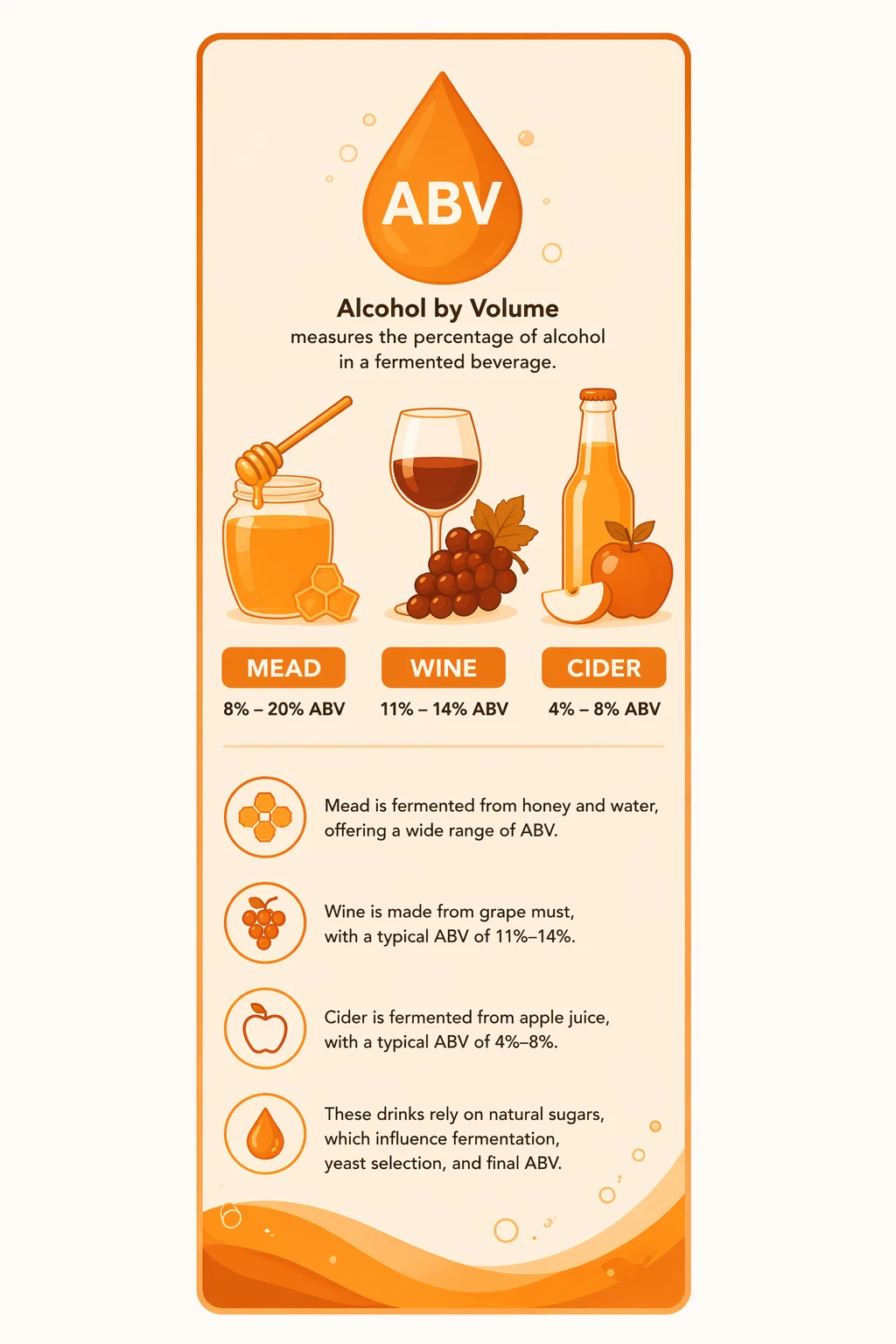
Alcohol by Volume (ABV) measures the percentage of alcohol present in a fermented beverage, while the concept remains the same across all drinks. Mead, wine, and cider each have different alcohol ranges and fermentation patterns that set them apart from beer and other beverages.
Mead, which is fermented from honey and water, produces a wide range of ABV from 8% to 20% depending on how much honey is used and how far fermentation proceeds.
Wine, fermented from grape must, generally ranges between 11% and 14% ABV. Hard cider, made from fermented apple juice, usually ranges from 4% to 8% ABV.
Unlike beer, which is brewed from malted grains and hops, these three beverages rely on natural sugars, honey, grape sugars, and apple sugars as their primary fermentable source. This difference in sugar source directly affects the fermentation process, yeast selection, and final alcohol content.
.
Comparison Table
| Beverage | Primary Sugar | ABV Range | Formula Constant |
| Mead | Honey | 8–20% | 131.25 |
| Wine | Grape Must | 11–14% | 136 |
| Cider | Apple Juice | 4–8% | 131.25 |

Why Wine Uses a Different ABV Constant (136)
This is one of the most important points people often miss in beverage ABV calculation. Most ABV calculators use the constant 131.25, which was developed primarily for beer. However, wine fermentation uses a slightly different constant: 136.
Why Is the Constant Different?
The constant in the ABV formula reflects how gravity changes and ethanol production. Wine fermentation differs from beer fermentation in a few key ways:
Because of this difference, using 131.25 for wine can slightly underestimate the actual ABV. The constant 136 corrects for this and gives a more accurate result.
Wine ABV Formula:
ABV = (OG − FG) × 136
Comparison Example:
- OG = 1.090, FG = 1.000
- Using 131.25: ABV = 0.090 × 131.25 = 11.81%
- Using 136: ABV = 0.090 × 136 = 12.24%
The difference may seem small, but for wine labeling, competition entry, or recipe formulation, this precision matters. Our wine ABV calculator uses the correct constant of 136 for wine calculations.
How to Calculate Mead ABV
Meadmakers calculate ABV in the same way as other fermented beverages by comparing liquid density before and after fermentation. However, mead uses honey as its fermentable source, which gives it a unique gravity profile compared to grain-based or fruit-based drinks.
Honey as the Primary Fermentable
When honey is dissolved in water, it creates a sugar-rich liquid which is called honey must. The amount of honey used directly determines the Original Gravity (OG) of the must. More honey means higher OG, which means higher potential ABV.
Taking OG and FG Readings for Mead
Before fermentation, measure the original gravity of your honey using a hydrometer, and after fermentation is completed, measure the Final Gravity (FG) readings. Mead fermentation can take several weeks to months, so it is important to make sure the FG has stopped changing before recording it.
Mead ABV Formula
The standard formula used to calculate mead ABV is:
ABV = (OG − FG) × 131.25
Example:
- OG = 1.110 (high honey content)
- FG = 1.010 (most sugar fermented out)
- ABV = (1.110 − 1.010) × 131.25 = 13.12%
Dry Mead vs Sweet Mead
The difference between dry mead and sweet mead comes down to final gravity. A dry mead finishes at a very low FG (around 1.000 — 1.005), which means the most sugars have been converted to alcohol. A sweet mead keeps more leftover honey sugar, which gives a higher FG and slightly lower ABV despite the same starting gravity.
| Dry Mead | 1.080–1.120 | 0.998–1.005 | 10–16% |
| Cyser (Apple Mead) | 1.070–1.110 | 1.005–1.015 | 8–14% |
| Melomel (Fruit Mead) | 1.080–1.130 | 1.005–1.020 | 9–16% |
| Metheglin (Spiced Mead) | 1.080–1.120 | 1.005–1.020 | 10–15% |
| Semi-Sweet Mead | 1.080–1.120 | 1.010–1.020 | 8–14% |
| Sweet Mead | 1.100–1.150 | 1.020–1.040 | 8–16% |
| Mead Style | OG Range | FG Range | ABV Range |
Mead yeast selection also plays an important role. Wine yeasts like EC-1118 (Champagne yeast) have high alcohol tolerance up to 18–20%, which allows mead to ferment fully and reach higher ABV levels compared to general-purpose or low-tolerance yeast strains.
How to Calculate ABV in Wine
Winemakers calculate ABV using OG and FG readings taken from grape must, the freshly pressed grape juice that is the base for wine fermentation.

OG from grape must
The Original Gravity of grape must depends on the sugar content of the grapes, which varies by grape variety, harvest time, and growing conditions. Most grapes must have an OG between 1.070 and 1.100, giving wine its typical ABV range of 11–14%.
Effect of Residual Sugar on Wine ABV
Residual sugar is the natural grape sugar that remains unfermented in finished wine. Dry wine ferments fully, achieving maximum ABV, while sweet wine retains more sugar, keeping FG higher and ABV lower than its full potential.
Step-by-Step Wine ABV Calculation:
– Measure the OG of the grape must before adding the wine yeast
– Allow fermentation to complete fully
– Measure the FG of finished wine
– Apply the wine formula: ABV = (OG − FG) × 136
Wine Formula Example
OG = 1.085, FG = 1.002
ABV = (1.085 − 1.002) × 136 = 11.29%
How to Calculate ABV in Hard Cider
Hard cider ABV is calculated from fresh-pressed apple juice, which serves as the primary fermentable liquid. Apple juice has a naturally lower sugar content compared to honey or grape must, which is why cider typically produces a lower ABV than mead or wine.
Apple Juice Gravity | Fresh-pressed apple juice typically has an OG between 1.045 and 1.065, depending on the apple variety and ripeness. This naturally limits hard cider ABV to the 4–8% range without adding additional sugar. |
Cider Fermentation Process | Cidermakers ferment apple juice using either commercial cider yeast, wine yeast, or, in some traditional methods, wild fermentation using naturally occurring yeast on the apple skins. Wild fermentation produces more complex flavors but can be unpredictable in terms of final ABV. |
Hard Cider vs Sweet Cider | It helps to know the difference between hard cider and sweet cider. Sweet cider is simply unfermented apple juice that contains no alcohol, while hard cider is fully fermented apple juice that contains alcohol. The term “hard” specifically refers to the presence of alcohol from fermentation. |
Dry Cider vs Sweet Hard Cider ABV | Just like mead and wine, cider can be made dry or sweet depending on how fermentation is managed. Dry cider ferments fully to a low FG, resulting in higher ABV and no residual sweetness. Sweet hard cider is either back-sweetened after fermentation or fermentation is stopped early, retaining apple sugar and producing a lower ABV. |
Cider ABV Formula & example: | ABV = (OG − FG) × 131.25 Example:
|
Tools to Measure ABV in Mead, Wine & Cider
Mead makers, winemakers, and cider makers use the same fundamental tools as beer brewers, but their application differs slightly based on the nature of the liquid being measured.
Meadmakers and winemakers use a hydrometer to take OG readings from honey must, grape must, and apple juice, as well as FG readings after fermentation. However, honey must be very thick and viscous, so it is important to ensure the honey is fully dissolved in water before taking a reading.
A refractometer is particularly useful for winemakers and cider makers when sampling grape must or apple juice before fermentation, as only a few drops are needed. However, once alcohol is present after fermentation begins, refractometer readings require a correction factor because alcohol affects how light bends through the liquid.
For mead, a hydrometer is generally preferred over a refractometer for post-fermentation FG readings due to the density of honey-based liquids.
Frequently Asked Questions (FAQs)
Conclusion
This page covers everything you need to know about calculating ABV for mead, wine, and hard cider using Original Gravity and Final Gravity readings. Mead, fermented from honey, ranges from 8% to 20% ABV, wine from grape must typically falls between 11% and 14%, and hard cider from apple juice usually sits at 4% to 8%. Wine uses a slightly different constant compared to mead and cider because grape must ferments more completely and produces a higher alcohol yield per gravity point. Factors like honey variety, grape ripeness, apple type, yeast selection, fermentation temperature, and nutrient additions all play a role in the final alcohol percentage across all three beverages.