
You brewed a batch, fermentation looks done, and now you want to know exactly how strong it is. Enter your Original Gravity and Final Gravity readings above and the calculator gives you your ABV instantly. Whether you are brewing an all grain IPA, an extract pale ale, or a simple sugar wash, this homebrew ABV calculator works for any fermented batch where you have gravity readings.
How to Calculate ABV for Your Homebrew?
Every homebrew ABV calculation starts with two gravity readings: one taken before fermentation and one taken after. The difference between those two numbers tells you how much sugar was converted into alcohol. From there, a formula turns that gravity drop into an alcohol percentage.
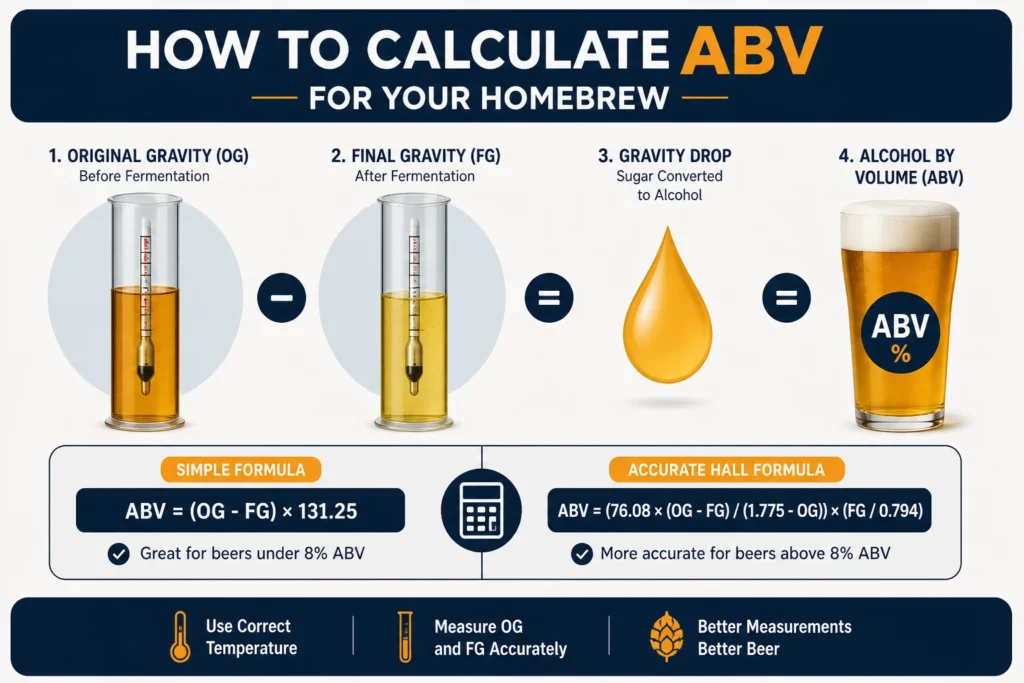
The Simple Homebrew ABV Equation
The simple formula is what most homebrewers learn first and use most often:
ABV = (OG − FG) × 131.25
Example: OG = 1.055, FG = 1.015 ABV = (1.055 − 1.015) × 131.25 = 5.25%This formula is fast, easy to remember, and accurate enough for most standard-strength beers. It works well for any batch finishing below 8% ABV.
The Accurate Hall Formula for Higher ABV Brews
For bigger beers, the simple formula starts to drift. The Hall formula gives a more precise result:
ABV = (76.08 × (OG − FG) / (1.775 − OG)) × (FG / 0.794)
Using the same example: OG = 1.055, FG = 1.015 ABV = (76.08 × 0.040 / (1.775 − 1.055)) × (1.015 / 0.794) = 5.25%
At this gravity, the results are nearly identical. Now try a barleywine: OG = 1.120, FG = 1.030 Simple formula: 11.81% ABV Hall formula: 12.05% ABV
The gap widens as alcohol increases because the simple formula does not account for the density effects of ethanol itself. The Hall formula corrects for this.
When Does the Formula Choice Actually Matter?
For beers below 8% ABV, both formulas give results within 0.1% of each other. Use whichever you prefer.
For beers above 8% ABV, the Hall formula gives a meaningfully more accurate result. The accuracy gap at high gravity matters for competition entries and bottle labeling.

How to Tell ABV in Homebrew: Three Methods Compared
Not every homebrewer has the same equipment. Here is how to determine ABV depending on what tools you have available.
Hydrometer Method: Most Reliable for Homebrew
A hydrometer gives you a direct density reading of your liquid at any stage of fermentation. Take a reading before you pitch your yeast to get OG, and take another reading once fermentation is complete to get FG. Plug both into the formula above and you have your ABV. This is the gold standard for homebrew ABV measurement because it is direct, low-cost, and not affected by alcohol content the way a refractometer is.
Refractometer Method: Fast But Needs Correction
A refractometer only needs a drop of liquid to give a reading, making it ideal for quick OG checks on brew day. The problem is that once alcohol is present, it interferes with the reading. Always apply a correction formula before using a post-fermentation refractometer reading as your FG. The full correction method is covered below. A brix to alcohol calculator can give you a quick potential ABV estimate straight from that refractometer reading before fermentation starts.
Estimation Without a Pre-Fermentation OG Reading
If you forgot to take an OG reading before pitching your yeast, you have a few options:
- Use a recipe calculator to estimate your OG based on ingredients and batch size
- Use the expected OG from your recipe sheet as a starting point
- Accept that your ABV estimate will be approximate rather than measured
None of these are as accurate as an actual gravity reading. Taking OG before fermentation takes 30 seconds and removes all uncertainty from your final ABV calculation. It is worth building into your brew day routine.
How to Use a Hydrometer to Calculate Homebrew ABV
A hydrometer is the most important measurement tool in a homebrewer’s kit. Understanding how to use it correctly is the difference between an accurate ABV reading and a number that is off by half a percent or more.
What Is a Triple Scale Hydrometer?
A triple scale hydrometer has three measurement scales printed on the paper insert inside the glass tube:
- Specific Gravity (SG): The primary scale used for ABV calculation, ranging from approximately 0.990 to 1.170
- Brix / Sugar: Measures sugar concentration as a percentage, used more commonly in winemaking
- Potential ABV: Gives a rough estimate of maximum alcohol if fermentation runs to completion
For ABV calculation, always use the SG scale. The potential ABV scale on the hydrometer is a rough guide based on full attenuation and should not be treated as a precise measurement.
How to Read a Hydrometer Correctly
Most beginner errors with a hydrometer come from reading it incorrectly rather than from the tool itself.
- Fill your sample tube or trial jar at least three quarters full so the hydrometer floats freely without touching the sides or bottom
- Spin the hydrometer gently when you place it in the sample to dislodge any bubbles clinging to the glass
- Read the scale at the bottom of the meniscus, not the top. The liquid curves upward where it meets the glass, and the correct reading is at the flat bottom of that curve
- Take the reading at eye level, not from above or below
A reading taken from the wrong part of the meniscus can shift your result by 0.001 to 0.002 SG points, which translates to 0.1 to 0.3% error in your final ABV.
When to Take OG and FG Readings
For OG: Take your reading after the wort has cooled and is in your fermenter, before you pitch the yeast. If you are brewing all grain, take a pre-boil reading as well so you can track your brewhouse efficiency.For FG: Do not rush this reading. Take your first FG reading when visible fermentation activity has stopped, then confirm it with a second reading 48 to 72 hours later. If both match, fermentation is complete. Packaging before FG stabilizes is one of the most common causes of over-carbonation.
Digital Hydrometer vs Analog Hydrometer
Traditional glass hydrometers are inexpensive, accurate, and require a sample volume of around 100 to 200ml. The main disadvantages are fragility and the need to cool samples before reading.
Digital hydrometers, most commonly the floating wireless type, sit inside your fermenter throughout the entire fermentation and log readings continuously without requiring you to pull samples. They sync to a phone app and let you track the full fermentation curve in real time.
The tradeoff: digital hydrometers are significantly more expensive than glass hydrometers, typically ranging from $130 to $180. For most homebrewers, a glass hydrometer is sufficient. For brewers who want fermentation data without opening the fermenter, a digital option is worth considering.
Hydrometer Temperature Correction for Accurate ABV
A hydrometer reading is only accurate at the temperature it was calibrated for. Every reading taken at a different temperature needs to be corrected before you use it in your ABV calculation.
Why Temperature Affects Your Hydrometer Reading
Liquid density changes with temperature. Warm liquid is less dense than cool liquid. When your wort is warmer than the calibration temperature, it sits lower on the hydrometer scale than it should, giving you a falsely low gravity reading. A wort reading taken at 90°F without correction can understate your OG by 0.003 to 0.005 SG points, which adds up to 0.4 to 0.65% error in your final ABV.
Calibration Standard: 59°F vs 68°F
Check the paper insert inside your hydrometer tube. Most hydrometers sold in the United States are calibrated at 60°F (15.6°C). Many European and laboratory grade hydrometers are calibrated at 68°F (20°C). Using the wrong calibration temperature in your correction formula will introduce an error rather than remove it.
Temperature Correction Formula and Table
Corrected SG = Measured SG + (0.000132 × (T − Tcal))
Where T is your sample temperature in °F and Tcal is your hydrometer’s calibration temperature.
Sample Temperature
50°F (10°C)
60°F (15.6°C)
70°F (21°C)
77°F (25°C)
86°F (30°C)
95°F (35°C)
104°F (40°C)
Correction (calibrated at 60°F)
−0.001
0.000 (no correction needed)
+0.001
+0.002
+0.003
+0.005
+0.007
The simplest approach is to cool your sample to room temperature before measuring. A sample tube placed in cold water for five minutes brings wort from near-boiling temperatures down to a range where correction is minimal.
Why Refractometer ABV Readings Need Correction After Fermentation
A refractometer measures how much light bends as it passes through your sample. Before fermentation, the only dissolved substance affecting that light is sugar. After fermentation begins, ethanol is also present, and ethanol bends light differently than sugar does.

Wort Correction Factor (WCF) — What Is 1.04 and Why It Matters
Most refractometers are designed for measuring sucrose solutions, not wort. Wort contains more complex sugars than pure sucrose, which causes the refractometer to read slightly high. The Wort Correction Factor (WCF) adjusts for this.
The standard WCF used in most homebrew calculators is 1.04. If you have calibrated your refractometer against a known hydrometer reading and found a different correction value, use that instead. The default of 1.04 is accurate for most standard wort compositions.
Corrected Brix = Refractometer Brix Reading / WCF
Novotny Cubic Correction Formula for Final Gravity
Once alcohol is present in your sample, apply the Novotny correction to get an accurate FG from a refractometer reading:
Corrected FG = 1.0000 − 0.0044993 × (OG Brix) + 0.011774 × (FG Brix) + 0.00027581 × (OG Brix²) − 0.0012717 × (FG Brix²) − 0.0000072800 × (OG Brix³) + 0.000063293 × (FG Brix³)
This formula is what Brewer’s Friend and BeerSmith both use for refractometer FG correction. The calculator above applies this correction automatically when you select the refractometer input mode.
Refractometer vs Hydrometer — Which to Use and When
Use a refractometer for:
- Quick OG checks on brew day from a small hot sample
- Monitoring gravity during the boil
- Checking pre-boil gravity in all grain brewing
Use a hydrometer for:
- Confirming that fermentation is complete
- Taking your final gravity reading for ABV calculation
- Any post-fermentation measurement where you need an accurate density reading without correction
All Grain OG FG ABV Calculator for Homebrewers
All grain brewers calculate expected OG and FG before they brew, using grain bill data and yeast specifications. This pre-brew calculation helps confirm that the recipe is on target before a single pound of grain is milled.
How Brewhouse Efficiency Affects Your Expected Original Gravity
Brewhouse efficiency measures how much sugar you actually extract from your grain compared to the theoretical maximum. Most homebrewers achieve between 65% and 80% efficiency depending on their system, crush, and mash technique.
Expected OG = (Sum of (grain weight × PPG × efficiency)) / batch volume in gallons
Where PPG is points per pound per gallon for each grain type (base malts typically contribute 36 to 38 PPG).
If your brewhouse efficiency is 72% and your recipe was designed for 75%, your actual OG will come in lower than planned. When this happens:
- Add dry malt extract or table sugar to bring OG up to target
- Extend the boil to concentrate the wort
- Accept the lower OG and adjust your expected ABV accordingly
Expected FG from Yeast Attenuation
Every yeast strain has a published apparent attenuation range, typically between 70% and 85%. Use the midpoint of that range to estimate FG before you brew.
Expected FG = OG − ((OG − 1.000) × attenuation)
Example: OG 1.060, yeast attenuation 75% FG = 1.060 − ((1.060 − 1.000) × 0.75) = 1.060 − 0.045 = 1.015
Partial Mash ABV Calculation
Partial mash brewing combines a small grain mash with malt extract. The OG calculation adds the gravity contribution from both sources:
Total OG gravity points = (Mash extract points + LME or DME gravity points) / batch volume
Calculate ABV from the final OG and FG readings exactly as you would for any other batch. There is no separate formula for partial mash — the calculation is identical once you have accurate gravity readings.
How to Adjust If Your OG Comes in Low
If your pre-boil or post-boil OG is lower than your target, you have options before pitching yeast:
- Add light DME at 44 gravity points per pound per gallon to raise OG
- Add table sugar at 46 gravity points per pound per gallon
- Boil longer to evaporate more water and concentrate the wort
Each of these raises OG and therefore raises potential ABV. Document the addition so your final ABV calculation reflects the actual OG of the pitched wort.
Extract Brewing ABV — How It Differs from All Grain
Extract brewing uses pre-made malt extract (liquid or dry) instead of mashing whole grain. The OG calculation is more predictable because extract has a consistent gravity contribution that does not depend on mash efficiency.
LME (Liquid Malt Extract) contributes approximately 36 gravity points per pound per gallon. DME (Dry Malt Extract) contributes approximately 44 gravity points per pound per gallon.
Example: 6 lbs of light LME in a 5 gallon batch OG = (6 × 36) / 5 = 216 / 5 = 43.2 gravity points = 1.043 SG
Extract brewers typically hit OG more consistently than all grain brewers because there is no mash efficiency variable. If your OG comes in low with extract, the most likely causes are incomplete dissolving of the extract or a higher-than-expected final volume.
FG calculation and ABV calculation after fermentation are identical to all grain OG minus FG, multiplied by your chosen formula constant.
Apparent Attenuation vs Real Attenuation in Homebrew ABV Calculation
Most homebrewers calculate ABV and stop there. Understanding attenuation gives you a deeper read on fermentation performance and beer quality.
Apparent Attenuation and What It Measures
Apparent attenuation is the percentage of fermentable sugars that yeast consumed, calculated from the gravity change you measure with your hydrometer or refractometer.
Apparent Attenuation = ((OG − FG) / (OG − 1.000)) × 100
Example: OG 1.060, FG 1.012 Apparent Attenuation = ((1.060 − 1.012) / (1.060 − 1.000)) × 100 = 80%
The word “apparent” is important. Because alcohol is less dense than water, the hydrometer floats higher in finished beer than it would if the same amount of residual sugar were dissolved in water alone. This makes the FG appear lower than it truly is in terms of sugar content, which makes attenuation appear higher than it truly is.
Real Attenuation and Real Extract (RE)
Real extract accounts for the density-lowering effect of alcohol. It gives a more accurate picture of how much residual sugar is actually in the finished beer.
Real Extract = (0.1808 × OG°P) + (0.8192 × FG°P)
Where OG°P and FG°P are the original and final gravity values converted to degrees Plato. If you need the plato to specific gravity formula behind this conversion, it is covered in full on our dedicated calculator page.
Real attenuation is always lower than apparent attenuation by roughly 2 to 5 percentage points, depending on the alcohol content of the beer.
Alcohol by Weight (ABW) vs Alcohol by Volume (ABV)
ABV measures alcohol as a percentage of total liquid volume. ABW measures alcohol as a percentage of total liquid weight. Because alcohol is lighter than water, ABW is always lower than ABV for the same beer.
ABW = ABV × 0.789
A beer at 5% ABV has an ABW of approximately 3.95%.
ABW appears on some American light beer labels. Most international beer labeling uses ABV. For homebrew competition entry and general communication, always use ABV unless specifically asked for ABW.

What Happens to ABV When Homebrew Fermentation Gets Stuck
A stuck fermentation stops before yeast has consumed all available fermentable sugars. The FG remains higher than expected, which means ABV comes in lower than planned and the beer tastes sweeter than intended.
How to Identify a Stuck Fermentation
Adding more malt or fermentable Once you have confirmed two matching FG readings 48 hours apart, compare that FG against your target. If it is higher than expected attenuation suggests, fermentation has likely stalled .
Common causes of stuck fermentation in homebrew:
Does a Stuck Fermentation Lower Your Final ABV?
Yes, directly. If your target FG was 1.012 and fermentation stalls at 1.020, your ABV will be lower than planned.
Example: OG 1.060 Target FG 1.012 → ABV = 6.30% Stuck at FG 1.020 → ABV = 5.25%
That one point difference in FG costs you over 1% ABV and leaves residual sweetness in the finished beer.
How to Restart Stuck Fermentation
Always confirm the fermentation is actually stuck before taking action. Rushing to fix a fermentation that is not actually stuck is one of the most common homebrew mistakes.
How to Increase ABV in Homebrew
Higher ABV starts at the recipe design stage, not after fermentation begins. The most reliable way to build alcohol into a homebrew is to increase fermentable sugar before pitching yeast.
Adding Fermentable Sugars Before Fermentation
The most controllable way to raise potential ABV is to increase the OG of your wort. Every 9 to 10 gravity points added to OG adds approximately 1% to potential ABV.
Common sugar additions and their gravity contribution per pound per gallon:
Adding plain sugar raises ABV with minimal flavor impact. Adding malt extract raises ABV with more body and malt character. Choose based on what you want the finished beer to taste like, not just the ABV target.
Adding Adjuncts and Fermentables Mid-Brew
Adding fermentables after fermentation has started is called a staggered sugar addition. This technique is used in Belgian strong ales and some high-gravity American styles to keep yeast healthy and active throughout a long fermentation.
The principle is simple: instead of shocking yeast with an extremely high-gravity wort at pitching, you start at a moderate OG and add sugar in stages over the first few days of fermentation. This keeps osmotic stress on the yeast lower while still building a high final ABV.
If you add fermentables mid-fermentation, record the volume and gravity contribution of each addition. Your ABV calculation must account for the total fermentables added, not just the original wort OG.
Choosing a High-Attenuation Yeast Strain
Yeast attenuation directly affects final ABV. A yeast strain with 85% apparent attenuation will produce a drier beer with higher ABV than a strain with 70% attenuation, even from the same starting OG.
For maximum ABV, choose a yeast strain with:
- High apparent attenuation (80% or above)
- High alcohol tolerance matching or exceeding your target ABV
- Adequate pitch rate for the gravity of the wort
EC-1118 (Champagne yeast) tolerates up to 18% ABV and attenuates extremely aggressively. For beer styles where you want maximum fermentation without the clean neutral flavor of wine yeast, look for high-attenuation ale strains like WLP099 or Wyeast 3787.
Priming Sugar and Its Effect on Final ABV
Priming sugar is added at bottling to create carbonation through a small secondary fermentation inside the bottle. The alcohol contribution is small but real. For standard carbonation levels it adds 0.1 to 0.2% ABV, enough to factor in for competition entries, small enough to round for general brewing.
For homebrew competition entries where ABV accuracy matters, factor priming sugar into your final ABV. For general brewing purposes, the contribution is small enough to round.
OG FG ABV Reference Chart
Use this chart to look up approximate ABV based on your OG and FG readings. Values are calculated using the simple formula (OG − FG) × 131.25.
| FG \ OG | 1.035 | 1.040 | 1.045 | 1.050 | 1.055 | 1.060 | 1.065 | 1.070 | 1.075 | 1.080 |
| 0.998 | 4.9% | 5.5% | 6.2% | 6.8% | 7.5% | 8.1% | 8.8% | 9.5% | 10.1% | 10.8% |
| 1.000 | 4.6% | 5.2% | 5.9% | 6.6% | 7.2% | 7.9% | 8.5% | 9.2% | 9.9% | 10.5% |
| 1.002 | 4.3% | 5.0% | 5.6% | 6.3% | 6.9% | 7.6% | 8.3% | 8.9% | 9.6% | 10.2% |
| 1.004 | 4.1% | 4.7% | 5.5% | 6.0% | 6.7% | 7.3% | 8.0% | 8.6% | 9.3% | 10.0% |
| 1.006 | 3.8% | 4.5% | 5.1% | 5.8% | 6.4% | 7.1% | 7.7% | 8.4% | 9.1% | 9.7% |
| 1.008 | 3.5% | 4.2% | 4.9% | 5.5% | 6.2% | 6.8% | 7.5% | 8.1% | 8.8% | 9.5% |
| 1.010 | 3.3% | 3.9% | 4.6% | 5.3% | 5.9% | 6.6% | 7.2% | 7.9% | 8.5% | 9.2% |
| 1.012 | 3.0% | 3.7% | 4.3% | 5.0% | 5.6% | 6.3% | 7.0% | 7.6% | 8.3% | 8.9% |
| 1.014 | 2.8% | 3.4% | 4.1% | 4.7% | 5.4% | 6.0% | 6.7% | 7.4% | 8.0% | 8.7% |
| 1.016 | 2.5% | 3.1% | 3.8% | 4.5% | 5.1% | 5.8% | 6.4% | 7.1% | 7.7% | 8.4% |
| 1.018 | 2.2% | 2.9% | 3.5% | 4.2% | 4.9% | 5.5% | 6.2% | 6.8% | 7.5% | 8.1% |
| 1.020 | 2.0% | 2.6% | 3.3% | 3.9% | 4.6% | 5.2% | 5.9% | 6.6% | 7.2% | 7.9% |
| 1.022 | 1.7% | 2.4% | 3.0% | 3.7% | 4.3% | 5.0% | 5.6% | 6.3% | 7.0% | 7.6% |
| 1.024 | 1.4% | 2.1% | 2.8% | 3.4% | 4.1% | 4.7% | 5.4% | 6.0% | 6.7% | 7.4% |
For beers above 8% ABV, use the Hall formula for a more accurate result. The simple formula underestimates alcohol content in high-gravity beers.
Why Your Homebrew ABV Differs from Commercial Beer
Homebrew ABV readings are estimates based on density measurements. Commercial beer ABV is measured using gas chromatography or distillation methods that directly quantify ethanol content rather than inferring it from density change. A hydrometer calculates ABV indirectly; it measures liquid density and infers how much sugar was converted to alcohol, which introduces small errors under certain conditions.
Frequently Asked Questions (FAQs)
Conclusion
Knowing your homebrew ABV comes down to two accurate gravity readings and the right formula for your batch strength. A glass hydrometer remains the most reliable tool for most homebrewers, and temperature correction ensures those readings mean what they should. If you need a quick cross-check, the potential alcohol calculator on the main site gives you an instant result alongside your homebrew figures. For cider or mead batches specifically, a cider ABV calculator handles the same OG and FG inputs. Refractometer readings after fermentation always need correction before they are useful for ABV calculation. Build OG measurement into every brew day, confirm FG with two matching readings, and you will have a number you can trust every time you pour a glass. auraplusplus.com