ABV vs Proof in Alcohol, Complete Guide with Formulas
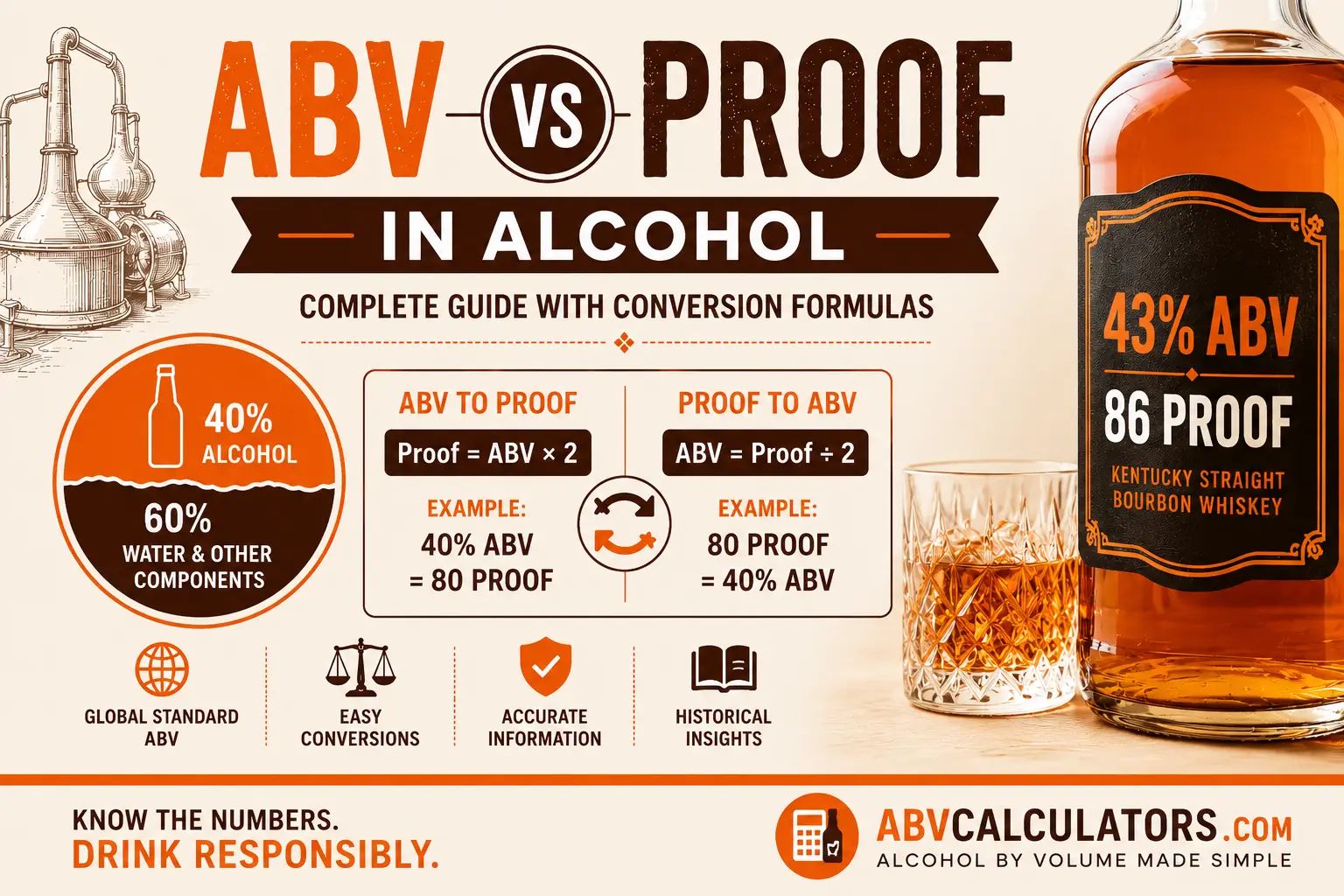
You pick up a bottle of bourbon and see two numbers sitting side by side on the label. One says 43% ABV. The other says 86Proof. Same bottle, same liquid, two different numbers. If you have ever wondered why ABV vs Proof exists and what the difference actually is, you are not alone. The confusion between ABV and proof trips up drinkers, homebrewers, and bartenders alike. This guide breaks down both measurements clearly, explains where proof came from, shows you how to convert between them instantly, and tells you which one you actually need to pay attention to.
What Is ABV?
ABV stands for Alcohol by Volume. It is the standard international measurement for how much pure alcohol is in any given drink, expressed as a percentage of the total liquid volume.
A beer at 5% ABV means that 5 out of every 100 millilitres in the bottle is pure ethanol. A vodka at 40% ABV means 40 millilitres out of every 100 millilitres is pure alcohol. The remaining percentage is water, flavour compounds, sugars, and everything else that makes the drink taste the way it does.
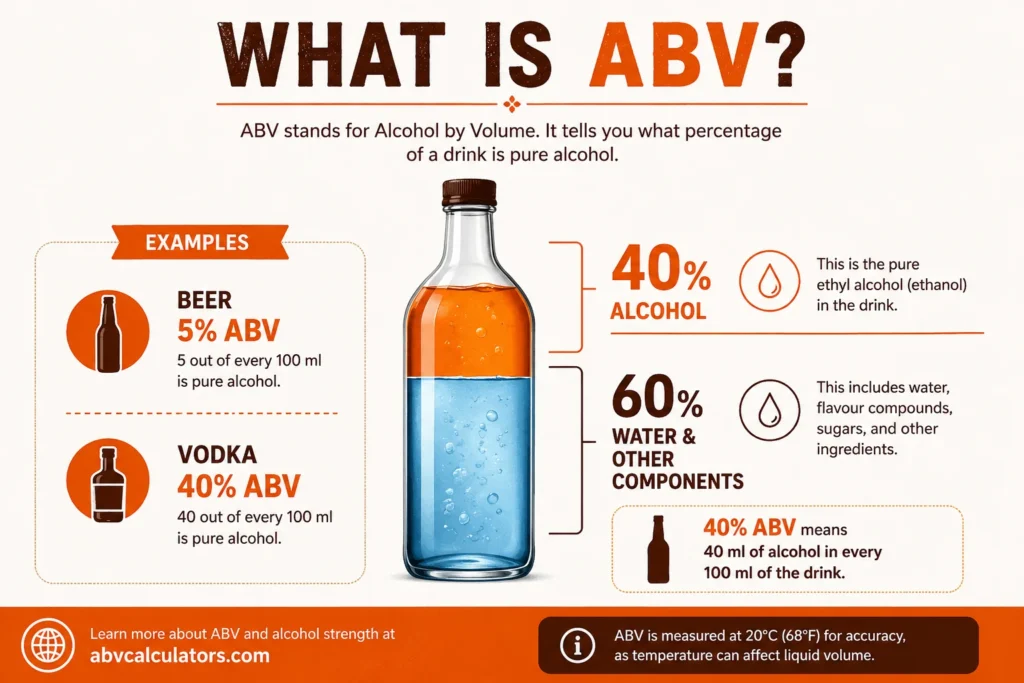
ABV is measured at a standard temperature of 20°C (68°F) because liquid expands and contracts with heat, and measuring at a consistent temperature keeps the reading accurate. This is the same reason hydrometers used in brewing and winemaking are calibrated to a specific temperature.
ABV is used worldwide. Every country that regulates alcohol labeling uses ABV as the standard unit. When you see a percentage followed by“vol” or “alc/vol” on a bottle, that is ABV.One important distinction: ABV measures volume, not weight. Alcohol by Weight (ABW) is a separate measurement that expresses alcohol content as a percentage of the drink’s total weight rather than its volume. Because alcohol is lighter than water, ABW is always a lower number than ABV for the same drink. A beer at 5% ABV is approximately 3.95% ABW. ABW appears on some American light beer labels but is rarely used outside that context. For everything else, ABV is the number that counts.
For a complete breakdown of what ABV means and how it works, see our What Is ABV guide.
What Is Proof in Alcohol?
Proof is an older measurement of alcohol strength that is still used today, primarily in the United States, on bottles of distilled spirits like whiskey, vodka, gin, rum, and tequila.
In the US, the relationship between proof and ABV is simple: proof is exactly double the ABV percentage.
A vodka at 40% ABV is 80 proof. A bourbon at 50% ABV is 100 proof. A rum at 75.5% ABV is 151 proof.
Proof is not a universal measurement. Different countries have defined it differently throughout history, which is one reason why ABV became the global standard. Today, proof as a formal label measurement exists almost exclusively on American spirits bottles. The reasons behind this go back to how the system was originally designed.
You will not see proof listed on beer or wine bottles, only on distilled spirits. The reason for this comes from the history of how proof was originally used, which goes back further than you might expect.
How to Convert ABV to Proof and Proof to ABV
The conversion between ABV and proof is one of the simplest calculations in the drinks world.
ABV to Proof Formula
To convert ABV to proof (US system), multiply the ABV by 2.
Proof = ABV × 2Examples: 40% ABV × 2 = 80 proof 46% ABV × 2 = 92 proof 57% ABV × 2 = 114 proof 63% ABV × 2 = 126 proof
Proof to ABV Formula
To convert proof back to ABV, divide the proof number by 2.
ABV = Proof ÷ 2Examples: 80 proof ÷ 2 = 40% ABV 100 proof ÷ 2 = 50% ABV 151 proof ÷ 2 = 75.5% ABV 120 proof ÷ 2 = 60% ABV
Quick Conversion Table (40% to 70% ABV)
ABV %
40%
43%
45%
46%
50%
57%
60%
63%
65%
70%
US Proof
80 proof
86 proof
90 proof
92 proof
100 proof
114 proof
120 proof
126 proof
130 proof
140 proof
UK °Proof (old)
70
75.25
78.75
80.5
87.5
99.75
105
110.25
113.75
122.5
French Gay-Lussac
40
43
45
46
50
57
60
63
65
70
Note: UK proof figures use the historical British system (ABV × 1.75). Shown here for reference when reading antique bottles or vintage spirits documentation.
Where Did Proof Come From? The Gunpowder Test
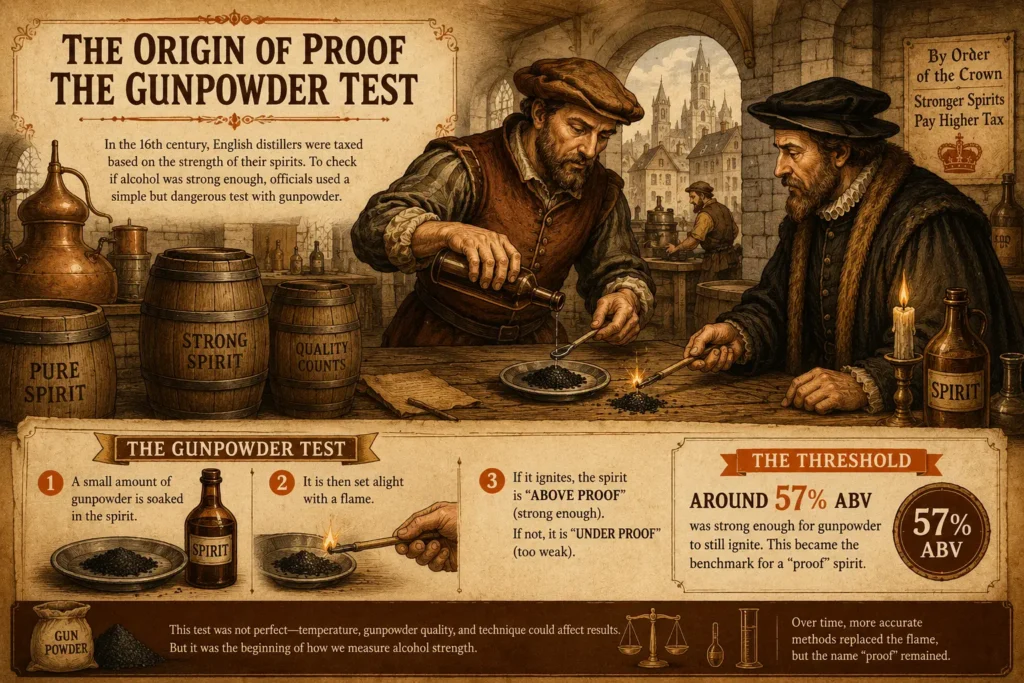
The word “proof” in the context of alcohol has a literal meaning. It was actual proof, in the sense of a test, that a spirit was strong enough.
The story starts in 16th-century England, where the government taxed spirits at different rates depending on their strength. Stronger spirits were taxed more heavily. The problem was that distillers could water down their product and nobody had a reliable way to check.
The solution was a physical test involving gunpowder. A pellet of gunpowder was soaked in the spirit. Someone then tried to light it. If the wet gunpowder still ignited, the spirit was strong enough to be taxed at the higher rate. If it fizzled out, the spirit was “under proof” and taxed less.
This threshold corresponded to roughly 57% ABV. At that concentration, enough ethanol is present that even gunpowder soaked in the liquid will still catch fire. Below 57% ABV, the water content is too high and the gunpowder will not ignite reliably.
That 57% threshold became the original definition of a “proof spirit” in England, meaning a spirit that had passed the test. The phrase “above proof” meant the spirit was stronger than 57% ABV, and “under proof” meant it was weaker.
The flammability test was obviously imprecise. The temperature of the room, the temperature of the liquid, and even the specific gunpowder used could all affect the result. By the 19th century, more accurate methods using hydrometers and specific gravity measurements had been developed, and the gunpowder test was retired.In1816,England formally standardized the proof system, defining a proof spirit as a liquid with an alcohol level equal to 12/13 the weight of an equal volume of distilled water at 11°C (51°F). That corresponded to approximately 57.06% ABV. This definition was incorporated into British customs and excise tax law in 1952 and remained in use until the UK switched to ABV in 1980.
US Proof vs UK Proof, Why the Numbers Are Different
The most common source of confusion around proof is that the UK and US systems are not the same. A bottle marked as 70 proof in the United States is a very different drink from a bottle marked as 70 degrees proof in the old British system.
The American Proof System
The United States established its proof system around 1848. American lawmakers wanted something simpler than the British approach. They defined proof as exactly twice the ABV, making 100 proof equal to 50% ABV.
This is the system that still exists in the US today. The Alcohol and Tobacco Tax and Trade Bureau (TTB) defines proof as the ethyl alcohol content of a liquid at 60°F, stated as twice the percentage of ethyl alcohol by volume. Under US law, ABV must be listed on all distilled spirits labels. Proof is optional, but most American distillers include both numbers because consumers are familiar with both. You will typically see them listed as something like “43% Alc. by Vol. (86 Proof)” on an American whiskey label.
The British Proof System
The British proof system, in use from the 16th century until 1980, was based on that 57% ABV threshold from the gunpowder test. Under the British system, 100 degrees proof equaled 57.15% ABV, not 50%.
To convert British proof to ABV, you multiply by 4/7 (approximately 0.571). To convert ABV to British proof, you multiply by 7/4 (approximately 1.75).
So a spirit at 40% ABV in the British system would be: 40 × 1.75 = 70 degrees proof
That same 40% ABV spirit in the American system is: 40 × 2 = 80 proof
Same spirit, same alcohol content, different proof number depending on which system is being used. A bottle labeled “70 proof” in the US (35% ABV) and a bottle labeled “70 degrees proof” in the old British system (40% ABV) are meaningfully different drinks. This is exactly the kind of confusion that led to the global adoption of ABV as the standard measurement.
The UK officially abandoned its proof system in 1980, adopting ABV in line with European Union standards. Modern British spirits bottles use ABV only. You will only encounter the old degrees proof notation on antique bottles, vintage spirits documentation, or historical references.
The French Gay-Lussac Scale
The French approach, developed by chemist Joseph-Louis Gay-Lussac in 1824, is the simplest of all three systems.
On the Gay-Lussac scale, the proof number equals the ABV percentage. 40% ABV is 40 degrees Gay-Lussac. 50% ABV is 50 degrees Gay-Lussac. Pure alcohol is 100. Water is zero.
In other words, the French proof and ABV are the same number. The Gay-Lussac scale is effectively what we now call ABV, just named differently. This is why France was well positioned when Europe moved to ABV as its standard.
The Gay-Lussac system is still occasionally referenced in French spirits documentation, but for practical purposes it is interchangeable with ABV.
Does Beer or Wine Have a Proof?
Technically, yes. Any alcoholic beverage has an equivalent proof value. A beer at 5% ABV would be 10 proof. A wine at 13% ABV would be 26 proof.
But you will never see proof listed on a beer or wine bottle, and the reason goes back to the gunpowder test. Beer and wine simply cannot ignite. Their alcohol concentration is too low for combustion to occur, which meant they were never subject to the proof-based taxation system in the first place. Proof was developed specifically for spirits, and it stayed a spirits measurement.
Today, this distinction holds by convention and regulation. In the United States, proof labeling is associated with distilled spirits. Beer and wine use a wine ABV calculator approach as their sole alcohol measurement method, and you will not see a brewer or winemaker express their product in proof on any commercial label. That said, if you want to express a beer’s strength in proof for any reason, the math works the same way. A double IPA at 9% ABV is 18 proof. A session beer at3.5% ABV is 7 proof. The numbers are just not used in practice.
How to Read Alcohol Labels Correctly
Understanding what you are looking at on a bottle label takes about thirty seconds once you know the system.
Here is what each label type shows and what to do with it:

Beer and wine labels
show ABV as a percentage followed by “vol” or “alc/vol.” That is the only alcohol measurement you need. No proof, no conversion required.
US spirits labels
show both ABV and proof side by side. ABV is legally required. Proof is optional but almost always included. Both numbers describe the same strength, use ABV if you want the universally understood figure.
Beer and wine labels
show ABV as a percentage with “vol” or “alc/vol.” No proof or conversion is needed because ABV alone measures alcohol strength clearly.
US spirits labels
usually display both ABV and proof together. ABV is legally required, while proof is optional but commonly added for easier strength reference.
Imported spirits labels
generally show only ABV on the bottle. Most countries outside the United States do not use proof as an alcohol measurement system.
Antique or vintage bottles
may display only proof values instead of ABV. Old US proof divides by 2, while British proof multiplies by 0.571.
One common source of confusion: the word“proof” sometimes appears casually in conversation or marketing to simply mean “strong.” A bartender saying a cocktail is “high proof” is using the word informally to mean it contains a significant amount of alcohol. This informal usage does not correspond to any specific calculation. It just means the drink is strong.
ABV and Alcohol Labeling Laws
Alcohol labeling requirements vary by country, but most major markets require ABV to be clearly stated.
In the United States, the TTB requires all distilled spirits to list alcohol content as a percentage of ABV. Beer and wine have similar requirements. The allowable tolerance is plus or minus 0.3% ABV from the stated figure, meaning a bottle labeled 40% ABV can legally contain anywhere from 39.7% to 40.3% ABV.
In the European Union, spirits, wine, and beer all must state ABV as a percentage on the label. The EU abandoned the old proof systems in favor of ABV in the 1970s and 1980s. EU regulations also set minimum ABV thresholds for different spirit categories. Vodka must be at least 37.5% ABV. Whisky must be at least 40% ABV. Gin must be at least 37.5% ABV.
In the United Kingdom, ABV is the only required measurement on spirits labels. EU regulations also apply minimum ABV thresholds, whisky must be at least 40% ABV, gin at least 37.5% ABV.
In Australia, ABV is required on all packaged alcohol. The label must show the number of standard drinks in the container alongside the ABV percentage, which helps consumers track their intake.
Why Does Proof Still Appear on Bottles Today?
If ABV is the global standard and proof is legally optional in the US, why do American distillers still include it?
The honest answer is tradition and branding.
American whiskey culture is deeply tied to the proof system. A bourbon described as “barrel proof” or “cask strength” sounds more powerful and evocative than the same bottle described as “63.5% ABV.” Terms like “100 proof” carry cultural weight in American spirits history. The 100 proof threshold was legally significant in US tax and trade regulations for decades.
There is also a practical element. Many American consumers are more familiar with proof than with ABV percentages, particularly older drinkers who grew up seeing proof on every bottle. Removing it would create confusion rather than clarity.
Some distilleries use proof as a product name or identity marker. “Old Forester 100 Proof” and “Wild Turkey 101” are brand names as much as they are alcohol measurements. Changing them to ABV-based names would mean renaming established products.In craft distilling, high proof expressions are often marketed as signs of quality and intensity. “Navy strength” gin at 57% ABV (114 proof) and “barrel proof” bourbon at 60% ABV or above (120 proof and higher) are positioned as premium, unadulterated spirits. The proof number in these cases serves as a shorthand for a certain philosophy of production.
ABV vs Proof: Which One Should You Use?
For nearly every practical purpose, ABV is the number to use.
ABV is universal. It means the same thing on a bottle bought in Tokyo, London, Sydney, or New York. Proof only means something specific if you know which country’s system is being referenced, and since the US is now the only country that uses it routinely, proof is effectively a US-specific measurement.
ABV is also more useful for calculations. Whether you are calculating the alcohol in a cocktail, estimating how many standard drinks a bottle contains, or using a brewing calculator to determine fermentation progress, ABV is the input those calculations need. Proof adds an extra step.
When should you pay attention to proof? When you are buying American spirits and the proof number is used as a product name or positioning statement. “Cask strength,” “barrel proof,” and “overproof” are terms associated with proof levels, and they tell you something meaningful about how the spirit was produced and how strong it will be.
When you encounter proof on a label, the conversion is always the same: divide by 2 to get ABV. That gives you a number that means the same thing regardless of where the bottle came from.
Common Proof and ABV Misconceptions
A few errors come up regularly in conversations about proof and ABV. Here are the most common ones worth clearing up:
Frequently Asked Questions (FAQs)
Conclusion
ABV and proof are two ways of expressing the same thing: how much alcohol is in a drink. ABV is the global standard, required on labels worldwide and used in every serious calculation involving alcohol content. Proof is an older system rooted in 16th-century English taxation, still used on American spirits labels by tradition and convention.
For most purposes, knowing that US proof equals double the ABV percentage is all you need. Divide any proof number by two and you have the ABV. That number tells you what you actually need to know about how strong a drink is. For everything else, including brewing calculations, cocktail planning, and comparing drinks from different countries, ABV is the measurement to use.