A Brix reading alone does not tell you much. Converting Brix to SG and ABV is the first step in turning a raw refractometer reading into something you can actually use. Calculate your potential ABV, correct for temperature, and get your specific gravity in one place. Whether you are working with grape must, apple juice, or honey must, enter your number and see exactly what your batch can achieve before fermentation begins.
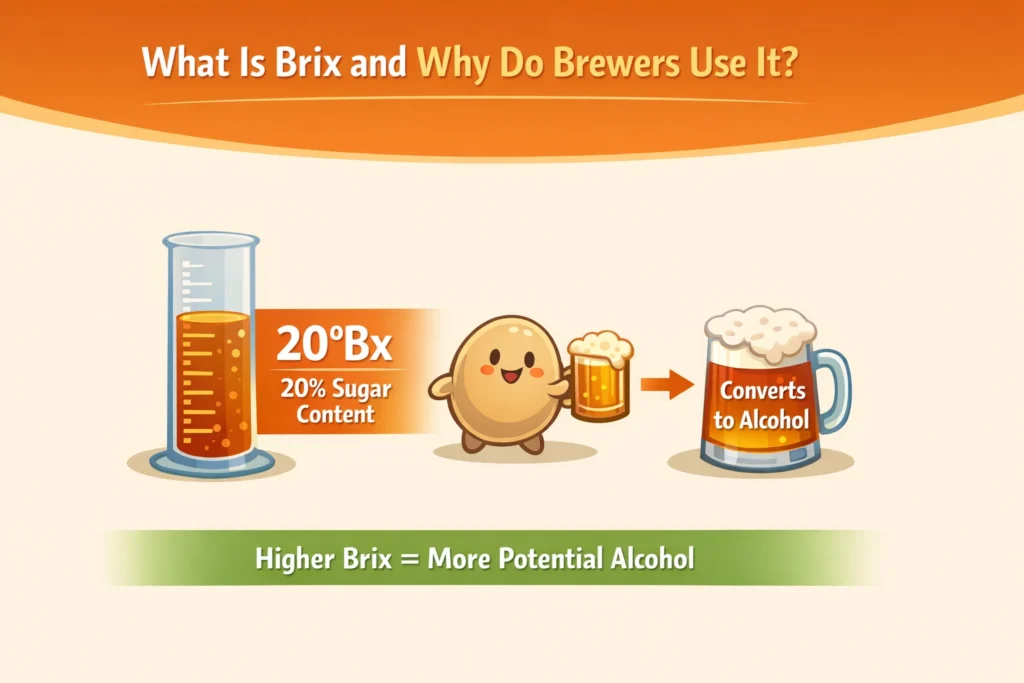
What Is Brix and Why Do Brewers Use It?
Brix (°Bx) measures sugar concentration in a liquid. One degree Brix means one gram of sucrose is dissolved in 100 grams of solution. A reading of 20°Bx tells you that roughly 20% of that liquid by weight is sugar.
Sugar is what yeast converts into alcohol during fermentation. So your Brix reading before fermentation gives you a direct estimate of how much alcohol your batch can potentially reach.
Different fermentation communities use different scales for the same thing:
Comparison Table
| Scale | Used By | Measures |
| Brix (°Bx) | Winemakers, food science | Sugar % by weight |
| Degrees Plato (°P) | Commercial brewers | Sugar % by weight |
| Specific Gravity (SG) | Homebrewers | Liquid density vs water |
All three scales measure dissolved sugar concentration; they just express it differently. The Brix, Plato, and Balling scales are close enough to use interchangeably at typical brewing ranges.

Brix vs Plato: Key Differences for Brewers?
Brix and Plato are not identical scales, but the difference between them is small enough that most brewers treat them as the same number.
The Balling scale was the original version, developed in the 19th century to measure sugar in solution. Degrees Plato is a more precise revision of Balling, adopted by professional brewers. Brix is the modern international standard used in winemaking and food science.
In typical brewing ranges (10°Bx to 30°Bx), Brix and Plato are almost identical, differing by less than 0.1. For homebrewers, converting between them usually isn’t necessary.
Where the difference matters:
Plato to SG Formula: SG = 1 + (°Plato / (258.6 − (0.8796 × °Plato)))
European Brix Equivalents: Oechsle, Baumé, and °KMW
Brix is the international standard, but it is not the only scale winemakers encounter. In several European wine regions, local measurement scales have been used for generations and are still printed on equipment, used in official documentation, and referenced in traditional recipes. If you are working with a German, Austrian, or French winemaking guide, you will likely come across one of these three scales.
Honey as the Primary Fermentable
When honey is dissolved in water, it creates a sugar-rich liquid, which is called honey must. The amount of honey used directly determines the Original Gravity (OG) of the must. A mead specific gravity calculator can confirm this OG reading before fermentation starts." More honey means higher OG, which means higher potential ABV.
Oechsle (°Oe): Germany and Switzerland
Oechsle measures the density of grape must as grams per liter above pure water. Since pure water weighs 1000 g/L, a must with a density of 1080 g/L corresponds to 80°Oe. German wine law uses Oechsle to define ripeness categories. Kabinett, Spätlese, Auslese, and higher Prädikat levels each require a minimum Oechsle at harvest. Swiss winemakers also use Oechsle as their standard ripeness measure.
- To convert Oechsle to Brix approximately: Brix ≈ Oechsle ÷ 4
- To convert Oechsle to specific gravity: SG = 1 + (Oechsle ÷ 1000)
- So, a must at 85°Oe is approximately 21.25°Bx and has an SG of 1.085
Baumé (°Bé): France
Baumé is used in France and several other wine-producing countries to express the sugar content of grape must. French winemakers commonly report harvest readings in Baumé, and many French hydrometers are graduated in this scale.
To convert Baumé to approximate ABV, French winemakers use a simple rule of thumb:
Each degree Baumé produces approximately 1% ABV after full fermentation
°KMW (Klosterneuburger Mostwaage): Austria
°KMW is the official ripeness scale used in Austrian wine law. It is named after the Klosterneuburg Wine Institute, where it was developed. Like Brix, it measures sugar percentage by weight, but it uses a slightly different calculation that accounts for the specific composition of grape must rather than pure sucrose solution.
At typical harvest ranges, °KMW and Brix values are close but not identical: Brix ≈ °KMW × 1.09
Austrian wine categories such as Kabinett, Spätlese, and Prädikatswein each carry minimum °KMW requirements that determine what label the wine may carry.
Quick Conversion Reference:
| Brix (°Bx) | Oechsle (°Oe) | Baumé (°Bé) | °KMW | SG |
| 16 | 64 | 8.9 | 14.7 | 1.064 |
| 18 | 72 | 10.0 | 16.5 | 1.072 |
| 20 | 80 | 11.1 | 18.3 | 1.083 |
| 22 | 88 | 12.2 | 20.2 | 1.092 |
| 24 | 96 | 13.3 | 22.0 | 1.100 |
| 26 | 104 | 14.4 | 23.9 | 1.109 |
Brix to Specific Gravity Conversion
Specific gravity (SG) compares the density of your liquid to pure water, which has an SG of exactly 1.000. Sugar dissolved in liquid makes it denser, pushing SG above 1.000.
Typical SG ranges before fermentation:
Before fermentation, typical SG readings depend on the liquid. Grape must usually falls between 1.070 and 1.110, while apple juice for cider reads lower at 1.045–1.065. Honey must for mead tends to run higher, anywhere from 1.080 to 1.130, depending on your honey-to-water ratio. The relationship between Brix and SG is nonlinear. As sugar concentration rises, density does not increase at a perfectly even rate; it curves. This is why a simple multiplier gives an approximate answer, but the polynomial formula gives an accurate one.
The calculator at the top of this page handles both directions automatically.
How to Calculate ABV from Brix
Brix-based ABV gives you the potential alcohol content, meaning the maximum alcohol your liquid can produce if fermentation completes fully.

Brix to ABV Conversion
Brix measures the sugar content in your liquid. Since sugar converts into alcohol during fermentation, Brix can be used to estimate potential ABV.
Each degree Brix produces roughly 0.55% to 0.60% ABV, depending on yeast efficiency and fermentation conditions.
Why Brix ABV is Only an Estimate
Brix-based ABV is always a potential value, not the final alcohol content.
If fermentation does not complete fully, some sugar remains unconverted, resulting in a lower actual ABV than calculated.
Step-by-Step Brix ABV Calculation
Measure the Brix of your juice before fermentation
Use the standard conversion factor and apply the formula:
ABV=Brix×0.59
Brix Formula Example
Brix = 20
ABV = 20 × 0.59 = 11.8%
Dry Wine vs Sweet Wine: How Brix Changes the Result
Two wines can start at the same Brix reading but finish at very different ABV levels depending on how fermentation is managed.
- Dry wine ferments almost all available sugar into alcohol. FG drops close to 1.000, and the actual ABV approaches the potential figure.
- Sweet wine retains unfermented sugar. FG stays higher, and ABV ends up lower than the Brix reading suggested, because not all that sugar became alcohol.
This is why harvest Brix alone does not determine final wine strength. How far fermentation runs matters just as much.
Typical harvest Brix for wine grapes:
- Below 20°Bx: May need chaptalization to reach standard ABV
- 20 – 24°Bx: Standard table wine range, 11–14% ABV
- Above 26°Bx: High-alcohol or dessert wine territory
Harvest Brix targets vary by wine style and grape variety. A winemaker's target Brix at picking is not just about alcohol; it is a balance between ripeness, acidity, and flavor development. Here are typical harvest Brix ranges for common wine styles:
| Wine Style | Target Harvest Brix | Expected ABV |
| Sparkling wine (base) | 17–19°Bx | 10–11% |
| Light white (Pinot Grigio, Riesling) | 19–21°Bx | 11–12.5% |
| Full white (Chardonnay) | 22–24°Bx | 13–14% |
| Light red (Pinot Noir) | 22–24°Bx | 13–14% |
| Full red (Cabernet Sauvignon, Shiraz) | 24–26°Bx | 14–15% |
| Late harvest/dessert wine | 28–35°Bx+ | 8–13% (fermentation stopped early) |
Step-by-Step Example: 25 Brix to Alcohol
A liquid starting at 25°Bx can reach approximately 14.75% ABV if fermentation completes fully. Yeast health, temperature, and available nutrients all affect whether it actually gets there.
Step 1: | Take a Brix reading before pitching yeast. Reading: 25°Bx |
Step 2: | Apply the formula ABV = 25 × 0.59 |
Step 3: | Result: your batch has a potential ABV of 14.75% |
Brix to Plato Conversion
For a direct Brix to Plato conversion, first convert Brix to SG using the formula above, then apply:
°Plato Formula: °Plato = −460.234 + (662.649 × SG) − (202.414 × SG²)
At typical fermentation starting points — 10°Bx to 26°Bx — Brix and Plato values sit within 0.1 of each other. The conversion becomes meaningful when matching a commercial recipe precisely or reporting in Plato for professional documentation.
Quick Reference Table: Brix → SG → Potential ABV
| Brix (°Bx) | Specific Gravity | Potential ABV |
| 10 | 1.040 | 5.9% |
| 15 | 1.061 | 8.9% |
| 18 | 1.074 | 10.6% |
| 20 | 1.083 | 11.8% |
| 22 | 1.092 | 13.0% |
| 24 | 1.100 | 14.2% |
| 25 | 1.104 | 14.75% |
| 26 | 1.109 | 15.3% |
| 28 | 1.118 | 16.5% |
| 30 | 1.127 | 17.7% |
Grape must at harvest typically falls in the 20–26°Bx range. Apple juice for cider usually measures 11–15°Bx. Honey must vary widely depending on the honey-to-water ratio. For values outside this table, use the calculator above for a precise result.
Sugar to ABV: How Added Sugar Changes Alcohol Potential
Sometimes, natural sugar levels in your juice or must are not enough to hit your target ABV. Brewers and winemakers add sugar directly to increase potential alcohol content, a process known by different names depending on the craft.
Brix of Common Adjuncts and Sugar Types
When brewers and winemakers add fermentable sugars to raise gravity, different sugar sources contribute different Brix equivalents per gram. This table shows the approximate Brix contribution of common adjuncts so you can calculate how much to add to hit your target OG.
Sugar / Adjunct
Table sugar (sucrose)
Corn sugar / Dextrose
Dry Malt Extract (DME)
Liquid Malt Extract (LME)
Raw honey
Maple syrup
Molasses
Brown sugar
Agave nectar
Type
Simple sugar
Simple sugar
Complex
Complex
Simple + complex
Mixed
Mixed
Simple
Simple
Brix per 100 g/L
9.5°Bx
9.1°Bx
7.5–8.0°Bx
5.5–6.0°Bx
8.5–9.0°Bx
5.5–6.5°Bx
6.0–7.0°Bx
9.0°Bx
7.5–8.5°Bx
Fermentability
~100%
~100%
~75%
~75%
85–95%
85%
~60–70%
~95%
~90%
Common Use
Chaptalization, sugar wash
Homebrewing, priming
All-grain, extract brewing
Extract brewing
Mead, braggot
Specialty beer, mead
Stout, dark beer
Belgian ale, dark beer
Specialty fermentation
Note that fermentability affects your actual ABV result. Corn sugar at 100% fermentability adds more alcohol per gram than LME at 75%, even if their Brix contributions appear similar. Always factor in fermentability when calculating expected ABV from adjunct additions.
Sugar Additions in Homebrewing
For all-grain homebrewers, a low pre-boil Brix reading is a signal to adjust before pitching yeast. Adding sugar raises OG directly.
Every 46 grams of sugar per liter raises SG by approximately 0.010 SG points, which adds roughly 1.3% to potential ABV.Sugar to ABV formula: ABV increase = (grams of sugar per litre × 0.0013) × 100
Priming Sugar
Priming sugar is added at bottling time in a small, precise dose. It triggers secondary fermentation inside the bottle, creating natural carbonation. It contributes very little to ABV, typically under 0.2%, but it is still a sugar-to-alcohol conversion happening in the bottle.
Using a Refractometer for Brix Readings
A refractometer measures how light bends through a liquid, a property called the refractive index. Sugar in solution bends light more than plain water, so a higher sugar concentration produces a higher Brix reading. The tool needs only a drop or two, making it practical for quick checks without disturbing your whole batch.
Brix Reading Before vs After Fermentation
This is where many homebrewers get caught out. A refractometer behaves differently depending on when you use it.
How to Correct Refractometer Readings After Fermentation (Sean Terrill Formula)
Before fermentation, a refractometer gives you an accurate reading because no alcohol is present. Once fermentation begins, alcohol starts interfering with the light refraction, so mid-fermentation readings need a correction applied before you can trust them. By the time fermentation is complete, the alcohol effect is significant enough that a raw refractometer reading is unreliable, at that stage, a hydrometer is the better tool for your final gravity.
Once alcohol forms in the liquid, it changes how light moves through the sample. Alcohol and sugar refract light differently, so a post-fermentation Brix reading without correction will be lower than the true value. Feed that raw number into an ABV formula, and your result will be off.
Refractometer correction formula for post-fermentation FG: Corrected FG = 1.0000 − 0.0044993(OGBrix) + 0.011774(FGBrix) + 0.00027581(OGBrix²) − 0.0012717(FGBrix²) − 0.0000072800(OGBrix³) + 0.000063293(FGBrix³)
For your definitive FG reading, a hydrometer is the more reliable choice. Use the refractometer for progress checks and the hydrometer to confirm your final number.
Calibrating Your Refractometer.
Place a drop of distilled water on the prism; it should read exactly 0°Bx. If it does not, adjust using the calibration screw. Most modern refractometers include ATC (Automatic Temperature Compensation), which handles minor temperature variation during measurement.
Temperature Correction for Accurate Brix and SG Readings
Hydrometers are calibrated at a fixed temperature, usually 60°F (15.6°C) or 68°F (20°C), depending on the model. When your sample is warmer or cooler than that point, the density reading shifts, and your ABV calculation shifts with it.
Why temperature matters:
Temperature Correction Formula: Corrected SG = Measured SG + (0.000132 × (T − Tcal))Where T = sample temperature, Tcal = hydrometer calibration temperature
Temperature correction reference:
At 60°F (15.6°C) — the standard calibration point — no correction is needed. Below that, at 50°F (10°C), subtract 0.001 from your reading. Above calibration, corrections increase gradually: add 0.001 at 68°F, 0.002 at 77°F, 0.003 at 86°F, and 0.005 at 95°F (35°C).
The simplest fix is letting your sample cool to room temperature before measuring. If that is not practical, use the temperature correction tab in the calculator above, enter your sample temperature, and the correction applies automatically.
Brix Ranges Across Different Fermentable Liquids
Brix applies to any sugar-containing liquid going into fermentation. Knowing the typical range for your source liquid helps you set realistic ABV targets before you start.

How Homebrewers Use Brix for ABV Calculation
For all-grain home brewers using a home brew alcohol calculator approach, a refractometer and Brix readings fit naturally into the brew day workflow.
Pre-Boil Gravity Check
Before the boil ends, take a Brix reading of your wort. This gives you a pre-boil gravity estimate using only a drop of liquid; there is no need to cool a full hydrometer sample. If the reading is lower than your recipe target, add malt extract or sugar to correct the OG before pitching yeast.
OG Recording and ABV Estimate
Convert your pre-fermentation Brix to SG for your OG record, then estimate potential ABV: ABV = Brix × 0.59
Mid-Fermentation Readings
During active fermentation, Brix readings give you a rough progress check, useful for confirming fermentation is still moving. But alcohol interference makes them approximate. Do not use mid-fermentation Brix readings as your FG.
Final Gravity Confirmation
When fermentation appears finished, switch to a hydrometer for your FG reading. This gives you an accurate final density unaffected by alcohol. From there, the standard OG/FG ABV formula gives you a reliable result.
Common Stuck Fermentation: Causes and Fixes
Common Mistakes When Using Brix for ABV Calculation
Frequently Asked Questions (FAQs)
Conclusion
A Brix reading alone is not sufficient for practical use in brewing or winemaking. It must be converted into specific gravity (SG) and potential alcohol by volume (ABV) to provide meaningful insights. While a refractometer is highly useful before fermentation, its readings become unreliable afterward unless corrected for alcohol interference. Accurate results also depend on proper calibration and temperature adjustments, and a hydrometer is preferred for final gravity measurements. Overall, Brix serves as a valuable starting point, but reliable fermentation analysis requires proper conversions and corrections.