
If you have ever pitched a single vial of liquid yeast into a 5-gallon batch and wondered why fermentation took three days to even start, underpitching is probably why. A fresh vial only holds about 100 billion cells, and a standard-gravity ale wort can call for nearly double that. This calculator works out how many cells your batch actually needs, checks whether your yeast pack still has enough life left in it, and tells you exactly how big a starter to build and how much DME to add.
Works for liquid yeast, dry yeast, and slurry, across ales, lagers, and high-gravity beers.
Do You Actually Need a Yeast Starter?
Whether you need a starter comes down to three questions: what type of yeast are you using, how old is it, and how strong is your beer.
Starters exist to solve a cell deficit. If the math below shows you already have enough viable cells, skip it and save yourself a day. If you’re newer to pitching live Saccharomyces cerevisiae cultures rather than dry sachets, our High ABV Homebrew Yeast guide covers strain selection alongside this cell-count math.
How Many Yeast Cells Does Your Batch Need?
Standard ale pitch rates run at 0.75 million cells per milliliter per degree Plato. Lagers need roughly double that, since cooler fermentation temperatures slow yeast reproduction and the yeast needs a bigger head start to finish cleanly.
Beer Type
Standard ale (under 1.060 OG)
High-gravity ale (over 1.060 OG)
Standard lager
High-gravity lager
Target Pitch Rate
0.75 million cells/mL/°P
1.0 million cells/mL/°P
1.5 million cells/mL/°P
2.0 million cells/mL/°P
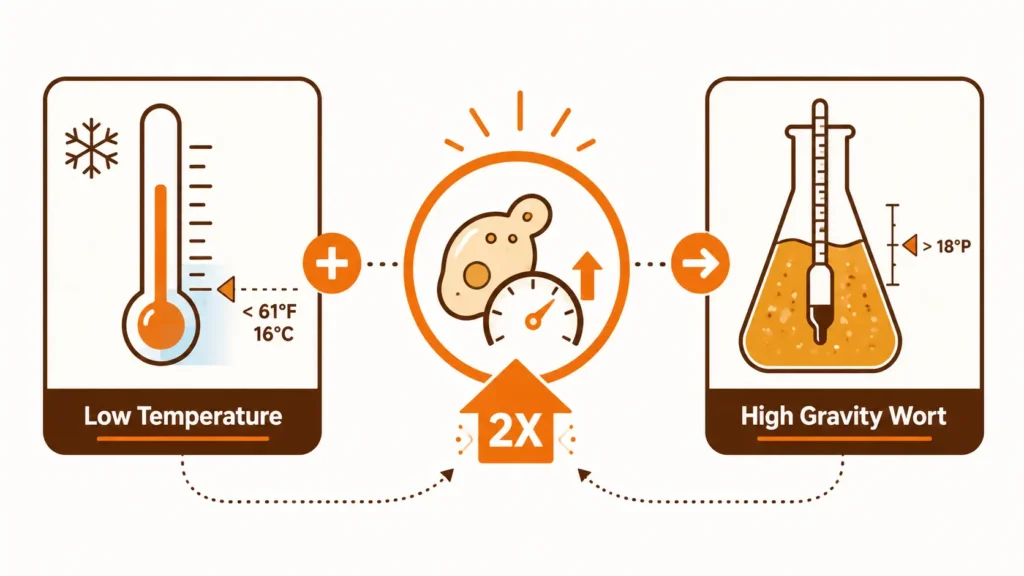
Two other factors push the pitch rate higher on their own. Fermenting below 61°F (16°C) roughly doubles the recommended rate, since cold temperatures inhibit yeast activity. A high-gravity wort above 18°P does the same, since the yeast is working in a more stressful, viscous environment. If both conditions apply at once, triple the standard rate.
Cell Counts by Yeast Source
Not every liquid yeast pack contains the same number of cells, and this catches people out when they do the math by hand.
| Yeast Source | Approx. Cells per Pack |
| Standard liquid yeast (Wyeast and most generic vials) | 100 billion |
| White Labs vials | ~150 billion |
| Imperial Yeast pouches | ~200 billion |
| Slurry (harvested yeast) | ~1 billion cells/mL (can range up to 5 billion/mL) |
Dry yeast is a different story, and it’s worth understanding why. There is no real consensus on how many cells are in a gram of dry yeast. Fermentis lists conservative figures above 6 billion cells per gram for strains like US-05 and S-04. Danstar lists above 5 billion per gram for Nottingham. A peer-reviewed study of several dry strains found a wider range of 8 to 18 billion cells per gram, depending on the strain.
Mr. Malty, a long-standing pitch rate reference among homebrewers, claims 20 billion per gram, though no cited study backs that number. In practice, a reasonable working default is around 10 billion cells per gram, which puts a standard 11g pack somewhere around 100 to 110 billion cells, closer to the manufacturer figures than to Mr. Malty’s estimate.
Worked Example
Say you’re brewing a 5-gallon batch of ale at 1.050 OG, using one fresh vial of standard liquid yeast (100 billion cells).

Step 1: Find the target cell count.
At the standard ale pitch rate of 0.75 million cells/mL/°P, a 5-gallon batch at 1.050 OG needs roughly 176 billion cells.
Step 2: Check what you actually have.
One fresh vial gives you 100 billion cells, a shortfall of about 76 billion cells, roughly 43% short of target.
Step 3: Decide on a starter.
With a deficit this size, a starter makes sense. A 2-liter starter at 1.036 SG, run on a stir plate, will typically close most of that gap.
Step 4: Size the DME.
Using the standard estimate of about 45 gravity points per pound per gallon for DME, a 2-liter starter at 1.036 SG needs roughly 190 grams of DME dissolved in the water before pitching.
That single vial, once stepped up through the starter, should land close enough to the 176 billion cell target for a healthy, on-time fermentation. Once fermentation finishes, you can check your final ABV with our Homebrew ABV Calculator.
Braukaiser vs. Chris White: Which Growth Model Should You Trust?
Two calculators can give different starter results from the same inputs, and the reason usually comes down to which growth model is running underneath.
| Model | Developed By | How It Works | Best Suited For |
| Braukaiser | Kai Troester | Growth measured in billions of cells per gram of extract, no upper growth ceiling in the current formula | Stir plate starters specifically; can run high on very large starters (5L+) |
| Chris White | Chris White & Jamil Zainasheff (Yeast: The Practical Guide to Beer Fermentation) | Empirical growth factor based on inoculation rate, capped at a 6x maximum growth factor | General-purpose starters, including shaken or unaerated starters |
Neither model is universally correct. Braukaiser’s numbers come from stir-plate-specific data, so they tend to track closer to reality if you’re running a stir plate. Chris White’s model was built from a broader range of aeration methods, including starters that were only shaken rather than stirred, so it reflects that scenario more directly when you don’t have a stir plate.
Yeast Viability: Why the Pack Date Matters
Liquid yeast is alive, and it starts dying the moment it’s packaged. Most calculators, including this one, assume viability drops by about 21% per month, or roughly 0.7% per day, in a straight line from the manufacture date.
This is why two brewers pitching “one vial” of the same strain can get very different results. A vial three weeks old might only contribute 80 billion viable cells rather than the 100 billion printed on the label, which is often the quiet reason a fermentation starts slower than expected.
What Happens If You Underpitch or Overpitch
Underpitching gives the yeast more room to grow and reproduce, which increases yeast-derived flavor. This works in your favor for styles like wheat beers, Belgians, and saisons, where fruity esters are welcome. Taken too far, though, underpitching leads to stalled fermentations, poor cleanup of off-flavors like acetaldehyde and fusel alcohols during maturation, and a higher chance of mutations affecting how the yeast flocculates in later generations.
Overpitching does the opposite. Less room for the yeast to grow means less yeast-derived character, which suits cleaner-fermenting beer styles. But it can also cause sluggish fermentations across repeated generations, since the yeast cells are older on average with less room to refresh themselves through growth.
Building the Starter: Gravity and DME
Frequently Asked Questions (FAQs)
Conclusion
Getting yeast pitching right comes down to three numbers: how many cells your batch needs, how many viable cells you actually have, and how big a gap sits between them. Dry yeast almost always covers that gap on its own, while liquid yeast, especially older packs or high-gravity batches, usually needs a properly sized starter to close it. Whether you lean on the Braukaiser model or Chris White’s growth curve, the goal stays the same: enough healthy cells at pitching time to avoid a stalled, sluggish, or off-flavor-prone fermentation. Run the numbers before brew day, not after you notice fermentation lagging, and the rest of the process takes care of itself.