
Chaptalization is the process of adding sugar to grape must before or during fermentation to raise its Brix level and increase the finished wine's potential alcohol content. This calculator determines exactly how much sugar to add to hit your target Brix, and how much water to add if your must came in too high instead. It works for grape wine, fruit wine, and cider musts, using either cane sugar or dextrose.
If your must came back low on the hydrometer this year, you're not alone. A cool growing season or an early harvest can leave grapes short on natural sugar, which means a wine that finishes thinner and lower in alcohol than planned. Chaptalization fixes that.
What Is Chaptalization, and Do You Really Need a Calculator?
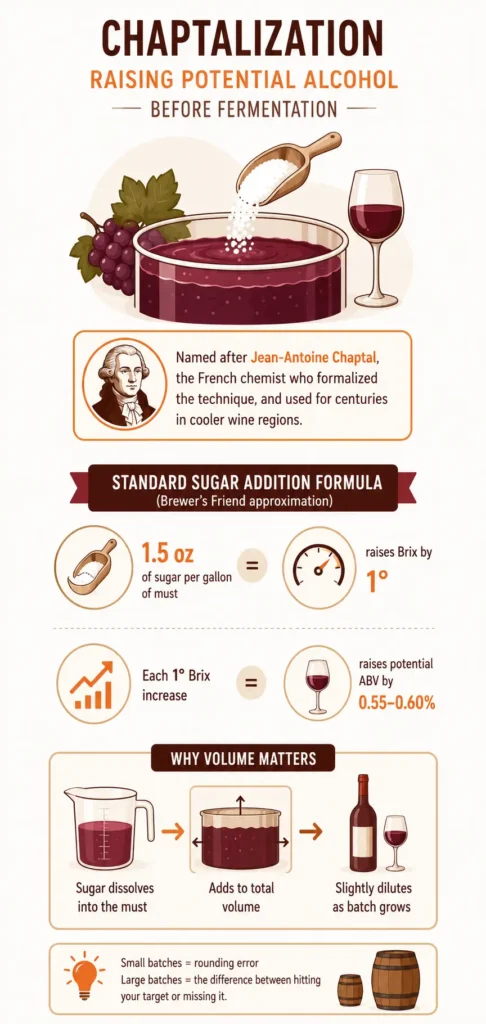
Chaptalization raises the potential alcohol of a wine by adding sugar to the must before fermentation. It's named after Jean-Antoine Chaptal, the French chemist who formalized the technique, and it has been standard practice in cooler wine regions for centuries whenever a vintage comes in short on natural ripeness.
Standard sugar addition formula (Brewer's Friend approximation):
Adding 1.5 oz of sugar per gallon of must raises Brix by approximately 1°.
Each 1°Brix increase raises potential ABV by roughly 0.55–0.60%.
Some winemakers argue you don't need a calculator at all, since it's simple sugar-to-alcohol math you can do in your head. There's truth to that for small batches. Where the math gets less simple is volume: sugar dissolves into the must and adds to its total volume, which means the amount you add also dilutes itself slightly as the batch grows. For a 5-gallon batch, that's a rounding error. For a 50-gallon batch, it can be the difference between hitting your target and missing it by half a point of ABV.
Must Volume vs. Wine Volume: The Detail Most People Miss
For red wine, chaptalization calculations should use expected finished wine volume, not starting must volume, since pressing removes roughly 35% of the total. A common estimate: 11.5 gallons of must yields approximately 7.5 gallons of finished wine.
This matters because sugar dissolves into whatever volume it ends up in. When you're chaptalizing red wine, you add sugar to the must before pressing, but the volume you'll actually bottle is the wine volume after pressing, not the must volume you started with. White wine, pressed before fermentation, doesn't have this issue in the same way, since the juice volume is already known before sugar is added.
Get this wrong and you'll typically under-chaptalize, adding sugar based on a volume larger than what you'll actually end up with.
Worked Example: Raising Brix
Say you've got 10 gallons of must sitting at 19°Brix, and your target for a dry red wine is 23°Brix.
Step 1: Find the Brix gap.
23 − 19 = 4°Brix to add.
Step 2: Apply the sugar formula.
10 gallons × 4°Brix × 1.5 oz = 60 oz, or 3 lb 12 oz of sugar.
Step 3: Dissolve and add.
Warm a portion of your must or some water to around 80–90°F, dissolve the sugar completely, let it cool to room temperature, then stir it gently into the must.
That addition brings the must from 19°Brix to approximately 23°Brix, landing in range for a dry red wine finishing around 12.1–13.8% ABV.
What If Your Must Is Too High? Dilution
If must comes in above target Brix, add water using this formula: Final Volume = (Initial Volume × Initial Brix) ÷ Target Brix. The difference between final and initial volume is the amount of water to add.
Worked example: Must at 26°Brix, target 24°Brix, starting volume 10 gallons.
Final volume = 10 × 26 ÷ 24 ≈ 10.8 gallons. That means adding roughly 0.8 gallons of water to bring the must down to 24°Brix. This is the same mass-balance principle used for chaptalization, applied in the opposite direction.
Cane Sugar vs. Dextrose: Which Should You Use?
This table compares the two most common sugars used for chaptalization.
| Sugar Type | Fermentability | Brix Increase | Notes |
| Cane sugar (sucrose) | 100% | ~1.8°Brix per lb/gal | Standard, widely available, neutral flavor |
| Dextrose (glucose) | 100% | ~1.9°Brix per lb/gal | Roughly 5% less needed by weight for the same Brix increase; tends toward cleaner fermentation |
Cane sugar is the default most home winemakers use, since it's cheap and available at any grocery store. Dextrose is worth considering for a marginally cleaner fermentation profile or if it's already on hand from brewing.
Brix and Potential ABV by Wine Style
This table shows typical target Brix ranges and their resulting potential alcohol by wine style.
Wine Style
Dry white wine
Dry red wine
Sweet white wine
Fruit wine
Fortified wine
Brix Range
20.0–23.0
22.0–25.0
22.0–28.0
18.0–24.0
26.0–30.0
Potential ABV
11.0–12.6%
12.1–13.8%
12.1–15.4%
9.9–13.2%
14.3–16.5%
At the higher end of these ranges, yeast health matters more. A must pushed toward 26–28°Brix or beyond puts real osmotic stress on yeast, which is where a strain with strong alcohol tolerance, such as Lalvin EC-1118, makes a meaningful difference in whether fermentation finishes cleanly.
Is Chaptalization Legal Where You're Making Wine?
Chaptalization legality varies by region: it's permitted with limits across much of the European Union, commonly capped around a 3.0°Brix increase, but prohibited for quality wine production in California.
Rules differ elsewhere, so if you're making wine commercially, or want to stay consistent with regional tradition, checking local regulations before chaptalizing is worth the five minutes it takes. For home winemaking purely for personal use, these restrictions typically don't apply the same way, but the context explains why some regions treat chaptalization as routine and others avoid it almost entirely.
Risks of Over-Chaptalizing
Pushing Brix too high creates three specific problems
The fix for all three: know the target Brix before starting, and add sugar in measured amounts rather than rounding up.