
If you have ever bottled a beer that came out weaker than you expected, or watched your refractometer show a Brix reading that made no sense once fermentation kicked in, you already know the problem. A refractometer is fast and needs only a couple of drops of liquid, but once alcohol enters the picture, it starts lying to you. This calculator fixes that. Enter your original and final Brix readings, apply your wort correction factor, and get a corrected final gravity and alcohol by volume you can actually trust.
Use it for homebrew beer, wine, cider, or mead. The math is the same wherever the sugar came from.
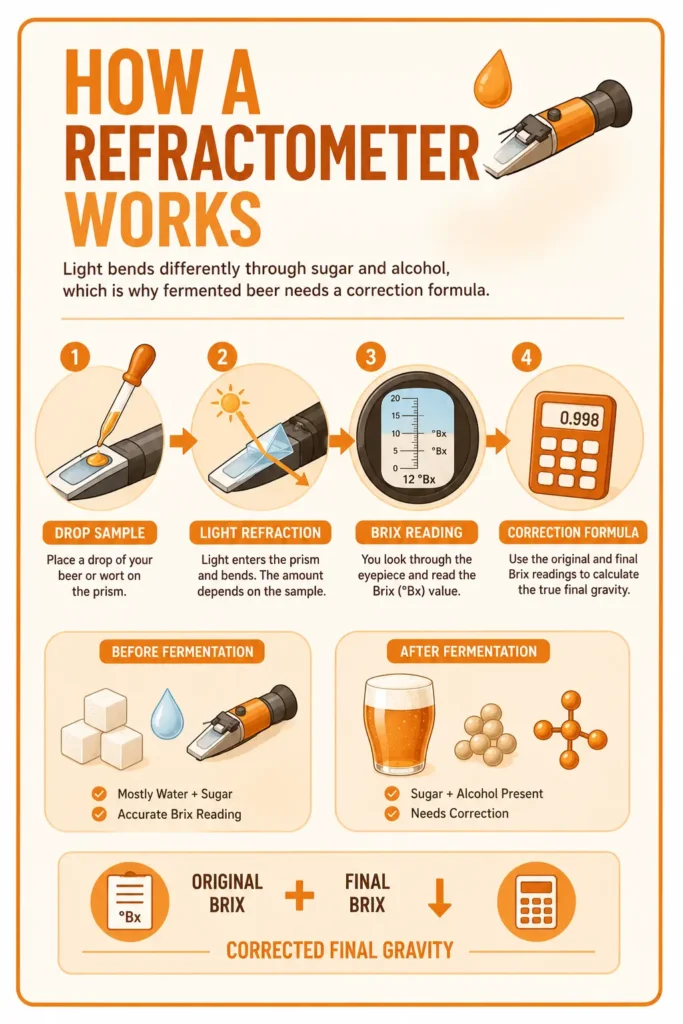
How a Refractometer Works
A refractometer measures how much light bends as it passes through a liquid sample. Dissolved sugar bends light more than water does, and that bend shows up as a shadow line on a scale you view through the eyepiece. The scale is read in degrees Brix (°Bx), which is roughly the percentage of dissolved solids by weight.
Before fermentation, this reading is reliable. Wort at that stage is mostly water and sugar, so a Brix reading converts to specific gravity with very little error. Once yeast starts working, though, alcohol appears in the sample, and alcohol bends light differently than sugar does. The refractometer cannot tell the difference, so it reports a Brix value that looks higher than the beer’s real remaining sugar content. Left uncorrected, this makes your beer look far less fermented than it actually is.
That is the entire reason a correction formula exists. It takes your original Brix reading (before fermentation) and your final Brix reading (after fermentation) and works backward to give you the true final gravity.
Brix to Specific Gravity Quick Reference
For pre-fermentation readings, the conversion from Brix to specific gravity is simple, no alcohol correction needed. Here are common values for quick reference.
| Brix (°Bx) | Specific Gravity | Approx. Potential ABV |
| 6 | 1.023 | 3.0% |
| 8 | 1.031 | 4.1% |
| 10 | 1.040 | 5.2% |
| 12 | 1.048 | 6.3% |
| 14 | 1.057 | 7.4% |
| 16 | 1.065 | 8.5% |
| 18 | 1.074 | 9.6% |
| 20 | 1.083 | 10.8% |
These figures assume the wort ferments all the way down to 0°Bx, which rarely happens in practice. Your actual ABV will come in lower once real attenuation is factored in, which is exactly what the correction formula below is for.
The Wort Correction Formula
Every refractometer needs a wort correction factor (WCF) before its readings mean anything. Most refractometers ship with a default WCF of 1.04, though the true value for your specific unit can range from 1.02 to 1.06. You divide your raw reading by the WCF to get the corrected Brix value.
For post-fermentation readings, the most widely trusted correction is the one developed by homebrewer Sean Terrill after comparing thousands of refractometer and hydrometer readings side by side. It is a cubic formula that takes your corrected original Brix (OB) and corrected final Brix (FB) and returns the true final gravity:
FGtrue = 1.0000 − 0.0044993(OB) + 0.011774(FB) + 0.00027581(OB)² − 0.0012717(FB)² − 0.0000072800(OB)³ + 0.000063293(FB)³
Once you have FGtrue, alcohol by volume is calculated the standard way:
ABV% = (OG − FG) × 131.25
Worked Example
Say you take a refractometer reading of 12.5°Bx before pitching your yeast, using a refractometer with a WCF of 1.04.
After fermentation finishes, your refractometer reads 4.16°Bx.
Now calculate ABV:
Without correction, that same 4.16°Bx reading would have been misread as a much higher final gravity, making the beer look far weaker and less attenuated than it really is. This is why bottling based on a raw, uncorrected refractometer reading is one of the most common mistakes new brewers make.

Refractometer vs Hydrometer: When to Use Each
Neither tool is strictly better. They are suited to different stages of the process.
A good workflow is to use the refractometer for speed on brew day and switch to a hydrometer, or the corrected refractometer math above, once you are close to packaging.
Which Correction Formula Is Most Accurate?
Homebrewers often notice that different calculators give different final gravity numbers from the same pair of readings, and it is a fair question to ask why. The answer is that several correction formulas exist, each built from a different dataset and intended for a slightly different use case.
Formula
Terrill (cubic)
Novotny
Barth & Race
Rogerson & Symington
Son et al.
Roesener
Developed By
Sean Terrill, 2011
P. Novotny, Zymurgy 2017
G. Barth 1905, modified by J. Race 1908
Rogerson & Symington, 2006
H. S. Son & colleagues, 2009
Werner Roesener, 2001
Best Suited For
General homebrew beer, most widely adopted across brewing tools
Beer, refined handling of mid-fermentation readings
Beer above roughly 4.5% ABV by weight
Port and other fortified wines, not accurate for dry wines
Wine, based on 30 wine samples measured before and during fermentation
Wine, popular among home winemakers though its derivation was never formally published
For most homebrewers making beer, Terrill’s formula is the safest default since it has been cross checked against hydrometer readings the most extensively. If you are working with wine, mead, or a fortified beverage, one of the wine-specific formulas will generally track closer to reality than a beer formula would.
How to Calibrate Your Refractometer
A refractometer that has never been calibrated will quietly throw off every reading you take with it, so this is worth doing before your first use and rechecking periodically.