
High ABV Homebrew Yeast: Best Strains & Tolerance Guide
Brewing a high ABV beer, wine, or mead sounds simple on paper. Add more fermentable sugar, pitch your usual yeast, and wait. In practice, most stalled batches trace back to one thing: the yeast reached its alcohol tolerance before it finished eating the sugar in front of it.
That gap between what your recipe promises and what your yeast can actually deliver is where most high-gravity brews go wrong. This guide walks through which yeast strains handle high ABV, how to read their attenuation numbers correctly, and how to use those numbers to predict your real ABV before you ever pitch.
What “Alcohol Tolerance” Actually Means
Alcohol Tolerance vs. Attenuation, Not the Same Thing
These two terms get used interchangeably, and that mix-up causes more stuck fermentations than bad recipes do.
Alcohol tolerance is the ABV level at which a yeast strain starts to slow down and eventually goes dormant, regardless of how much sugar is left in the fermenter. Once the surrounding alcohol concentration crosses that threshold, the yeast cells can’t keep working efficiently.
Attenuation is a separate measurement. It’s the percentage of sugar in your wort or must that the yeast is capable of converting into alcohol and CO2, assuming it never runs into an alcohol tolerance ceiling. A yeast can have high attenuation and still stall early in a high-gravity batch if its alcohol tolerance is low.
For a full breakdown of how attenuation is actually measured during fermentation, see our guide on real attenuation vs. apparent attenuation.
In short: attenuation tells you how thorough the yeast is. Alcohol tolerance tells you when it quits. For high ABV brewing, you need both numbers, not just one.
Alcohol Tolerance Tiers
Most yeast suppliers classify strains into rough tolerance bands rather than a single hard number, since tolerance shifts slightly based on yeast health, nutrients, and temperature:
If your target ABV sits above 10%, you’re already outside the range most standard ale and lager strains were built for, and need to be picking from the Very High or High tiers deliberately.
High-ABV Yeast Comparison Table (Beer, Wine & Mead)
Strain
Wyeast 3787 (Trappist High Gravity)
Wyeast 1388 (Belgian Strong Ale)
Wyeast 1728 (Scottish Ale)
White Labs WLP099 (Super High Gravity Ale)
Lalvin EC-1118 (Champagne Yeast)
Red Star Pasteur Champagne Yeast
Fermentis SafBrew HA-18
Alcohol Tolerance
~11-12%+ ABV
~12-13% ABV
~12% ABV
Up to 25% ABV (with sugar feeding)
~18% ABV
12%+ ABV
~18% ABV
Attenuation Range
74-78%
73-80%
69-73%
80-100%
Very high
High
High
Best-Use Beverage
Belgian dubbels, tripels, strong ales
Belgian golden strong ales
Scotch ales, barleywines, imperial stouts
Barleywines, imperial stouts, extreme beers
Wine, cider, mead, high-ABV beer finishing
Secondary pitch to push beer past a stalled beer yeast
Beer and cider requiring extreme tolerance
Two patterns are worth noticing here. First, the highest-tolerance options (EC-1118, WLP099, SafBrew HA-18) all sit at the top regardless of beverage type, since alcohol tolerance is more about the strain’s biology than what it’s fermenting. Second, several brewers use a wine or champagne yeast as a second pitch after their primary beer yeast taps out, rather than starting with it.
Pitch Rate, Starter Size & Oxygenation for High-Gravity Worts
Strain choice only pays off if the yeast is pitched in the right condition. High-gravity worts need noticeably more healthy cells than a standard-strength batch, and skipping this step is one of the most common reasons a technically “correct” yeast still underperforms.
From Yeast Attenuation to Predicted ABV, Do the Math
Picking a high-tolerance yeast is only half the job. The other half is confirming, with numbers, that the strain you picked can actually reach your target.
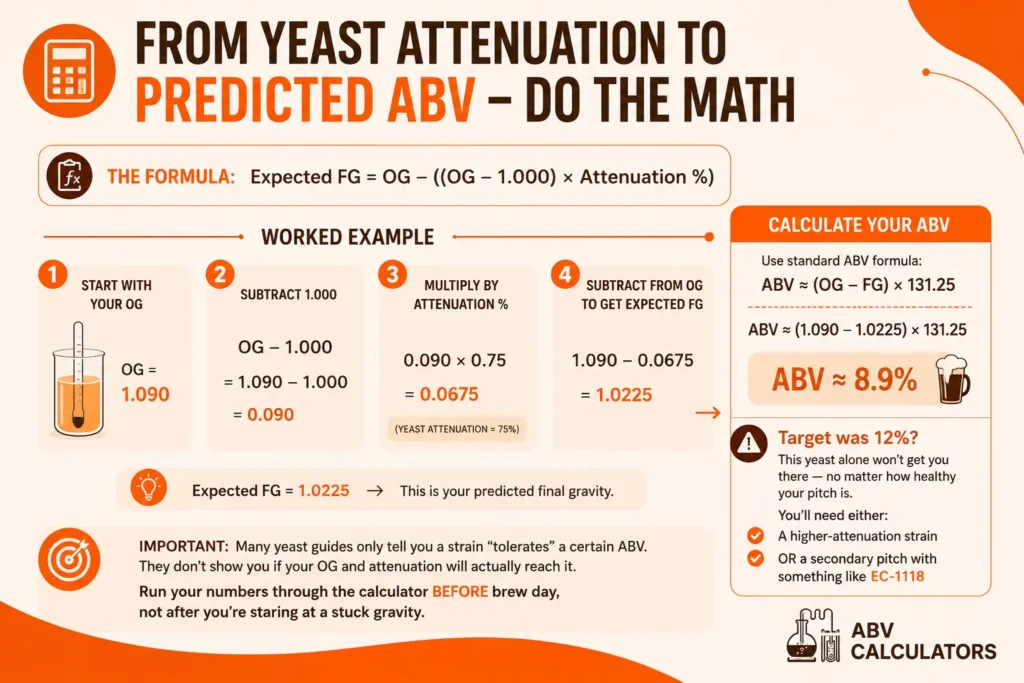
Here’s the formula our Homebrew ABV Calculator uses to predict your finishing gravity from a yeast’s attenuation range:
Expected FG = OG − ((OG − 1.000) × Attenuation %)
Worked example: Say your original gravity (OG) is 1.090, and you’re using a yeast rated at 75% attenuation.
Plug 1.090 and 1.0225 into a standard ABV formula and you land around 8.9% ABV. If your target was 12%, this yeast alone won’t get you there, no matter how healthy your pitch is. You’d need either a higher-attenuation strain or a secondary pitch with something like EC-1118.
This is the step most yeast comparison articles skip. They’ll tell you a strain “tolerates 12% ABV,” but they won’t show you how to check whether your specific OG and chosen strain will actually reach that number. Run your numbers through the calculator before brew day, not after you’re staring at a gravity reading that won’t budge.
When the Simple Formula Isn’t Enough
High Gravity Brewing and the Hall Formula
The standard ABV formula (OG − FG × 131.25) works fine for most everyday beers. Once you’re brewing above roughly 1.070 OG or pushing toward 8%+ ABV, though, that formula starts overestimating your actual alcohol content. The math behind it assumes a linear relationship between gravity and alcohol that breaks down at higher gravities. Our guide on which ABV formula to use breaks down exactly when to switch.
If you’re selecting a high-ABV yeast because you’re targeting a strong beer, wine, or mead, switch your calculator to the Hall Formula setting rather than the Simple Formula. The higher your OG climbs, the more that correction matters.
Reverse Engineering: How Much Sugar to Hit Your Target ABV
Sometimes the question isn’t “what will this yeast produce,” it’s “how much sugar do I need to add to reach a specific ABV.” This works off gravity points per pound of fermentable per gallon:
Worked example: You’re at 5 gallons, currently sitting at 1.050 OG, and want to reach 1.090 OG to hit a higher target ABV with a high-tolerance yeast like WLP099.
Add that sugar gradually rather than all at once. Dumping the full amount in early spikes the osmotic pressure your yeast faces right out of the gate, which is one of the more common reasons a high-gravity fermentation stalls in the first 48 hours. If you’re measuring gravity with a refractometer instead of a hydrometer, check our guide on hydrometer vs. refractometer readings for ABV since sugar and alcohol both skew refractometer readings once fermentation is underway.
Keeping High-ABV Yeast Healthy: Nutrients & Staggered Additions
High-ABV fermentations put yeast under more stress than a standard batch, and that stress compounds if nutrients run short partway through.
Fermaid-O, Fermaid-K, Go-Ferm, DAP
These are the standard nutrient products for wine, mead, and high-gravity fermentations:
What Is TOSNA (Staggered Nutrient Additions)?
TOSNA, short for Tailored Organic Staggered Nutrient Additions, spreads nutrient dosing across several points in the fermentation instead of adding it all upfront. A typical schedule adds nutrients at pitching, then again once fermentation is visibly active, and again partway through.
This approach isn’t just for mead. Any high-gravity fermentation, beer included, benefits from staggered nutrients rather than a single dose, since yeast demand for nitrogen shifts as fermentation progresses and alcohol concentration rises.
Bottling High-ABV Beer: Don’t Forget Priming Yeast
Why Standard Yeast Can Stall at 10%+ ABV
If your beer has been conditioning for months and you’re ready to bottle, the yeast still in suspension may be too stressed or too diminished in cell count to properly carbonate the beer, especially once ABV climbs past 10%.
Fermentis SafAle F-2 is built specifically for this scenario, marketed for bottle-conditioning beers above 10% ABV. Adding a small, fresh dose of priming yeast at bottling time, rather than relying on whatever survived months of fermentation, is a simple fix that a lot of high-ABV homebrewers skip until they end up with flat bottles.
Common Mistakes When Brewing High-ABV Batches
Frequently Asked Questions (FAQs)
Conclusion
Choosing a high-ABV yeast isn’t just about grabbing the strain with the biggest number on the label. It’s about matching that strain’s attenuation and tolerance to your actual OG, pitching enough healthy cells, feeding it properly through nutrients and staggered sugar additions, and confirming the math before brew day rather than after a stalled fermentation.
Plug your OG and your chosen strain’s attenuation range into the tool above to see your predicted ABV, and switch to the Hall Formula if you’re brewing above 1.070 OG for a more accurate result.