A Brix reading alone does not tell you much. An SG to Brix calculator helps you go either direction depending on what your equipment gives you. Calculate your potential ABV, correct for temperature, and get your specific gravity in one place. Whether you are working with grape must, apple juice, or honey must, enter your number and see exactly what your batch can achieve before fermentation begins.
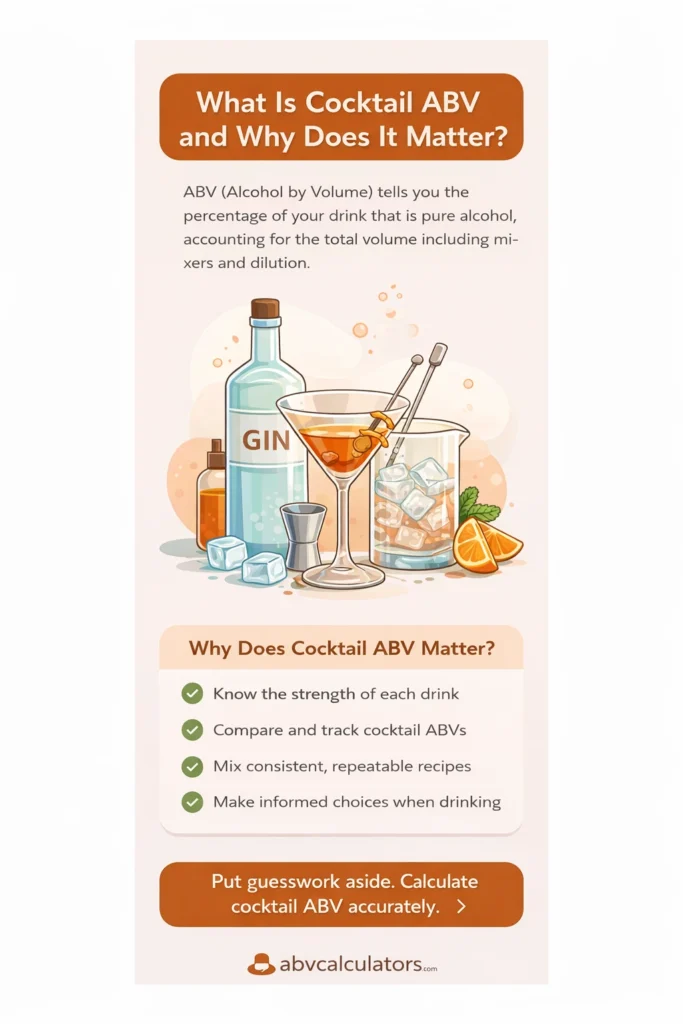
What Is Cocktail ABV and Why Does It Matter?
ABV (Alcohol by Volume) tells you what percentage of your drink is pure alcohol. A cocktail with 15% ABV means 15ml of every 100ml in the glass is alcohol.
Unlike a bottle of Vodka, where ABV is printed on the label, a cocktail is a mix of different ingredients in different volumes. The final ABV depends on what you put in, how much of each ingredient you use, and how much the drink dilutes when you shake or stir it.
Knowing your cocktail ABV matters for a few real reasons:
- You know exactly how strong each drink is before you serve it
- You can compare drinks and make informed choices about how much you consume
- Bartenders and bar managers can list accurate ABV on menus
- Home mixologists can dial in a recipe and repeat it consistently
There has been a growing movement toward mindful drinking, where people want to know the strength of what they are consuming rather than guessing. A cocktail ABV calculator puts that information in your hands before the drink reaches the glass.

How to Calculate Cocktail ABV?
Every cocktail ABV calculation comes down to one question: how much pure alcohol is in this drink compared to the total volume of liquid?
The formula is:
Final ABV = (Sum of [Volume x ABV] for each alcoholic ingredient) / Total cocktail volume x 100
You multiply each ingredient’s volume by its ABV to find the pure alcohol it contributes. Add those together. Divide by the total volume of the drink. Multiply by 100 to get a percentage.
Single Spirit Cocktail, Formula and Example
A single spirit cocktail has one alcoholic ingredient mixed with non-alcoholic mixers.
Example: Gin and Tonic
- 50ml gin at 40% ABV
- 150ml tonic water at 0% ABV
- 5ml lime juice at 0% ABV
- 15ml dilution from ice
That single gin and tonic, which feels like a light drink, sits at just over 9% ABV before you account for any further dilution in the glass.
Multi-Spirit Cocktail, Formula and Example
When a cocktail has two or more alcoholic ingredients, you calculate the pure alcohol from each one separately, then add them together.
Example: Mai Tai
- 40ml rum at 40% ABV
- 20ml orange curaçao at 35% ABV
- 25ml lime juice at 0% ABV
- 10ml orgeat syrup at 0% ABV
- 50ml dilution from shaking with ice
A Mai Tai looks tropical and refreshing. At nearly 16% ABV, it is stronger than most wines.
What Is the Difference Between Proof and ABV?
If you have ever looked at a bottle of American whiskey or vodka, you have probably seen a proof number alongside the ABV percentage. There are two ways of expressing the same thing, but the numbers look different.
In the US proof system, proof is exactly double the ABV. A bottle labeled 80 proof is 40% ABV. A bottle at 100 proof is 50% ABV. In the UK and most of the world, proof is no longer used on labels. ABV percentage is the standard measurement across Europe, Australia, and most international markets.
Comparison Table
| Label | US Proof | ABV % |
| Standard vodka | 80 proof | 40% |
| Overproof rum | 151 proof | 75.5% |
| Standard whiskey | 80 proof | 40% |
| Cask strength whiskey | 110 to 130 proof | 55 to 65% |
| Standard gin | 80 proof | 40% |
| Navy strength gin | 114 proof | 57% |
When you use this calculator, always enter the ABV percentage, not the proof number. If you only have the proof, divide it by 2 to get ABV.
How Dilution Affects Cocktail ABV
Ice does more than chill your drink. As it melts, it adds water to the cocktail, increasing total volume without adding any alcohol. That extra water lowers the final ABV.
Most cocktail recipes assume a certain amount of dilution depending on how the drink is made. Ignoring dilution in your calculation gives you an ABV that is higher than what actually ends up in the glass.
Stirred Cocktails
Stirred cocktails are made by stirring spirits over ice in a mixing glass for 30 to 60 seconds. This chills and dilutes the drink at the same time.
Typical dilution from stirring: 40 to 60ml of water
Cocktails in this category include the Martini, Old Fashioned, Negroni, and Manhattan. These are spirit-forward drinks with no juice or dairy, so they need controlled dilution to open up the flavors.
The type of ice matters here. Large ice cubes and ice spheres have a lower surface-area-to-volume ratio, so they melt more slowly and add less water. Bartenders use large-format ice in stirred cocktails specifically to control how much dilution happens.
Shaken Cocktails
Shaken cocktails go into a shaker with ice and are shaken vigorously for 10 to 15 seconds. The more aggressive agitation breaks up ice faster and adds more water.
Typical dilution from shaking: 50 to 80ml of water
Cocktails in this category include the Margarita, Daiquiri, Cosmopolitan, and Whiskey Sour. Shaken drinks often contain juice, egg whites, or dairy, and the shaking integrates those ingredients while chilling the drink.
Blended and Frozen Cocktails
Blended cocktails use a blender with ice, which crushes the ice completely into the drink. This adds significantly more water than stirring or shaking.
Typical dilution from blending: 100 to 150ml or more
A Piña Colada or Frozen Margarita served from a blender will have a noticeably lower ABV than the same recipe served over ice. The alcohol content is the same, but the total volume is much larger, so the percentage drops.
On the Rocks, Continuous Dilution Over Time
A drink served on the rocks keeps diluting throughout the entire time it sits in the glass. The first sip and the last sip are not the same ABV.
This continuous dilution is why experienced bartenders and whiskey drinkers pay attention to ice format when drinking spirits on the rocks:
For ABV calculation purposes, use an estimated dilution volume based on how long the drink will sit before being consumed.
How Does Alcohol Content Change When You Shake vs. Stir the Same Recipe?
Dilution changes alcohol strength, even when the recipe stays exactly the same.

Shaking vs Stirring: ABV Impact
Shaking and stirring do not change the ingredients, but they significantly affect dilution. As ice melts, it adds water to the drink, increasing total volume and reducing alcohol concentration (ABV).
Stirring typically adds around 40–60ml of water, while shaking adds 50–80ml due to more agitation. More dilution means a lighter drink with lower alcohol strength.
Why ABV Changes
Alcohol by volume depends on the ratio of pure alcohol to total liquid volume. Even when the alcohol content remains constant, adding water lowers the final ABV.
Stirred drinks tend to be stronger and more concentrated, while shaken drinks are more diluted and lighter. This difference shows how the preparation technique directly influences the perceived strength and balance of a cocktail.
How to Calculate ABV After Dilution
To determine the final ABV after dilution, first calculate the total pure alcohol in the drink. Then add the dilution water to get the new total volume.
Apply the standard formula:
ABV = (Pure Alcohol / Total Volume) × 100
This method allows you to compare how different preparation techniques impact the final strength of the same cocktail recipe.
Negroni Example
A Negroni made with 30ml gin (40%), 30ml Campari (25%), and 30ml vermouth (16%) contains 24.3ml of pure alcohol.
When stirred, the total volume becomes 140ml with an ABV of 17.4%. When shaken, volume increases to 155ml, and ABV drops to 15.7%.
The shaken version is approximately 1.7% lower in ABV due to higher dilution.
ABV of Common Spirits and Liqueurs
Before you can calculate cocktail ABV, you need to know the ABV of each ingredient going into the drink. Most standard spirits sit in predictable ranges, but liqueurs vary widely.
Spirits and Liqueurs ABV Reference Table
| Spirit / Liqueur | Typical ABV Range | Notes |
| Vodka | 40% | The US minimum is 40% by law |
| Gin | 40 to 47% | Navy strength gin reaches 57% |
| White rum | 37.5 to 40% | Overproof rums go up to 75.5% |
| White rum | 40% | Aging adds flavor, not alcohol strength |
| Blended Scotch whisky | 40% | Single malts often 43 to 46% |
| Bourbon | 40 to 50% | Cask strength can exceed 60% |
| Tequila | 38 to 40% | Blanco, reposado, and añejo have similar ABV |
| Mezcal | 40 to 55% | Often higher ABV due to traditional production |
| Brandy / Cognac | 40% | Typically aged, similar strength to whisky |
| Triple sec | 30 to 40% | Sweet orange liqueur used in many cocktails |
| Orange curaçao | 30 to 40% | Similar to triple sec but often richer flavor |
| Aperol | 11% | Similar to triple sec but often with a richer flavor |
| Campari | 25% | Bitter aperitif with moderate alcohol content |
| Baileys Irish Cream | 17% | Cream-based liqueur with lower ABV |
| Kahlúa | 20% | Coffee liqueur with moderate sweetness |
| Midori | 20% | Melon liqueur, bright color, & sweet profile |
| Amaretto | 21 to 28% | Almond-flavored liqueur with medium strength |
| Vermouth (dry) | 15 to 18% | Fortified wine, lower ABV than spirits |
| Vermouth (sweet) | 15 to 17% | Slightly sweeter, similar strength range |
| Beer | 4 to 8% | Varies widely depending on style |
| Wine | 11 to 14% | Depends on grape variety & region |
| Champagne / Prosecco | 11 to 12% | Sparkling wines used as cocktail toppers |
Cocktail Strength Classification: How Strong Is Your Drink?
Not all cocktails are equal in strength. Understanding where a drink sits on the strength scale helps you plan recipes, manage servings, and have honest conversations with guests about what they are drinking.
Strength Category
Session cocktail
Standard mixed drink
Strong cocktail
Spirit-forward cocktail
Very strong cocktail
ABV Range
Up to 10% ABV
Simple sugar
Complex
Complex
Simple + complex
Example Cocktails
Aperol Spritz
Mojito, Margarita
Negroni, Mai Tai
Martini, Manhattan
Neat Spirit
A session cocktail is generally defined as any cocktail at or below 10% ABV. These are drinks designed to be consumed over a longer period without a rapid increase in alcohol intake. The term comes from the UK pub tradition of session beers, which were low enough in ABV to drink over the course of an evening.
A spirit-forward cocktail like a Martini or Old Fashioned contains mostly spirits with minimal dilution from mixers. These drinks regularly reach 28 to 35% ABV before ice dilution, and still sit at 20 to 25% after dilution. They are significantly stronger than most people realize.
Cocktail ABV in ml vs oz, Does the Unit Matter?
The short answer is no, the unit does not change the ABV result, as long as you use the same unit consistently for every ingredient in the calculation.
ABV is a ratio of pure alcohol volume to total drink volume. Whether you measure everything in milliliters or fluid ounces, you are dividing one number by another number in the same unit, so the percentage comes out the same.
Where people run into problems is mixing units within one calculation. If you enter some ingredients in ml and others in oz without converting, your total volume will be wrong, and so will your ABV.
This calculator accepts both ml and oz. Pick one unit and stick with it for all ingredients in a single recipe. If you are working from a recipe that uses oz but want the result in ml, convert all volumes before entering them, or use the unit toggle in the calculator.
How Mixers Affect Final Cocktail ABV
Every non-alcoholic ingredient you add to a cocktail increases the total volume without adding any alcohol. That drives the ABV down.
This is straightforward in practice:
What Happens to ABV When You Top a Cocktail with Soda or Sparkling Wine?
Topping a cocktail is different from mixing one. When you build a drink in a glass and then pour soda, Prosecco, Champagne, or beer over the top, that topping liquid goes into your ABV calculation just like any other ingredient.
Most people forget this step. They calculate the base of the drink correctly and then pour 60 to 90ml of soda on top without factoring it in. The result is a calculated ABV that is higher than what is actually in the glass.
Here is how it works in practice:
Example: Aperol Spritz
- 90ml Prosecco at 11% ABV
- 60ml Aperol at 11% ABV
- 30ml soda water at 0% ABV
Pure alcohol: (90 x 0.11) + (60 x 0.11) = 9.9 + 6.6 = 16.5ml
Total volume: 90 + 60 + 30 = 180ml
ABV: (16.5 / 180) x 100 = 9.2% ABV
Now imagine you poured that soda without counting it. Total volume becomes 150ml instead of 180ml, and the calculated ABV jumps to 11%, which is wrong.
A few drinks where the topping changes the ABV calculation significantly:
The key rule is simple. Every liquid in the glass counts toward the total volume. If it goes in the glass, it goes in the calculation. Sparkling toppers that contain alcohol, like Champagne or Prosecco, also add to the pure alcohol total.
Common non-alcoholic mixers and their effect
Soda water and tonic add pure volume with zero alcohol, which has the most direct diluting effect on ABV
Fruit juices (lime, lemon, orange) are 0% ABV, but add flavor alongside volume
Syrups and liqueurs are different; syrups are 0% ABV, while liqueurs do contain alcohol, so they affect the calculation differently
Cream and egg whites add volume and change the texture, but contribute no alcohol
Always include every liquid ingredient in your calculation, including mixers, juices, and syrups. Leaving them out overstates the final ABV.
What Is a Batched Cocktail and How to Calculate Its ABV?
A batched cocktail is a large-scale version of a single-serving recipe, made in advance and served from a container rather than mixed to order. Batching is common at weddings, parties, bars, and events where making individual cocktails is not practical.
The ABV of a batched cocktail is calculated the same way as a single serving. The formula does not change. What changes is the scale.
Scaling a Single Recipe to a Batch
To scale a recipe, multiply every ingredient by the number of servings you need.
Example: Batching a Negroni for 20 people
Single serving:
- 30ml gin at 40% ABV
- 30ml Campari at 25% ABV
- 30ml sweet vermouth at 16% ABV
Multiplied by 20:
- 600ml gin
- 600ml Campari
- 600ml sweet vermouth
- Total volume: 1800ml (before dilution)
Pure alcohol: (600 x 0.40) + (600 x 0.25) + (600 x 0.16) = 240 + 150 + 96 = 486mlABV before dilution: (486 / 1800) x 100 = 27% ABV
Dilution in Batched Cocktails
This is where most people get batching wrong. When you make cocktails to order, each drink gets diluted by the ice during shaking or stirring. In a pre-batched cocktail that is poured straight from a bottle or jug, that dilution does not happen automatically.
You have two options:
For the Negroni batch above: 1800ml x 0.18 = 324ml water added New total volume: 2124ml New ABV: (486 / 2124) x 100 = 22.9% ABV
Pre-batching with added water gives guests a consistent drink every time.
Standard Drink Equivalents and Cocktail Strength
A standard drink is a unit used in public health guidelines to help people track how much alcohol they are consuming. In the United States, one standard drink contains 14 grams of pure alcohol, which works out to:
- 12oz of regular beer at 5% ABV
- 5oz of wine at 12% ABV
- 1.5oz of distilled spirit at 40% ABV
A cocktail can contain one standard drink, two standard drinks, or more; it depends entirely on the recipe.
To calculate how many standard drinks are in a cocktail:
Total pure alcohol in ml / 14 = standard drinks (US)
Example: A Mai Tai with 23ml of pure alcohol 23 / 14 = 1.64 standard drinks
That one cocktail is the equivalent of almost two standard drinks. Someone who thinks they are having one drink is actually consuming the alcohol of nearly two.
This calculation matters because standard drink limits in health guidelines are based on these equivalents. If cocktails contain more than one standard drink each, a person hits their daily limit faster than they realize.

Low ABV and Session Cocktails: How to Control Alcohol Content
Low ABV cocktails are not just about removing alcohol. A well-made session cocktail at 8% ABV can be just as satisfying as a strong one at 25%. The key is building flavor from the right ingredients rather than relying on high-proof spirits to carry the drink.
Ways to bring ABV down in a cocktail:
- Increase mixer volume: more soda, juice, or tonic relative to spirit lowers ABV without changing the spirit itself
- Use lower-ABV spirits: substitute a navy strength gin (57% ABV) with a standard gin (40%), and the ABV of the finished drink drops noticeably
- Use wine or vermouth as the base: wine-based cocktails like spritzes and wine cups naturally sit at lower ABV because the base spirit is 11 to 14% rather than 40%
- Substitute liqueurs for spirits: replacing a measure of vodka (40%) with a liqueur (20 to 25%) reduces the alcohol contribution of that ingredient
- Add dilution deliberately: serving a drink over crushed ice or adding sparkling water extends the volume without adding alcohol
Typical ABV range for low-ABV cocktail styles:
Vermouth-based cocktail: 12 to 16%
Cocktail ABV for Bar Menus: Why It Matters
Listing ABV on a cocktail menu is not standard practice yet, but it is gaining traction among forward-thinking bars and restaurants. Guests increasingly want to know what they are drinking, and providing that information builds trust.
From a responsible serving perspective, bartenders and bar managers who know the ABV of each menu drink can:
- Advise guests who ask how strong a drink is
- Identify drinks that are significantly stronger than they appear
- Make informed decisions about portion sizes for high-ABV cocktails
- Support guests who are drinking mindfully or moderating their intake
A Martini at 28% ABV and a Mojito at 12% ABV look similar in a glass but are very different drinks from a strength perspective. Listing ABV next to each cocktail on a menu gives guests the information they need to make their own choices.
Common Mistakes When Calculating Cocktail ABV
Frequently Asked Questions (FAQs)
Conclusion
Understanding cocktail ABV comes down to balancing pure alcohol with total volume, including dilution from ice and mixers. Whether you’re making a single drink or batching for a group, small changes in technique, ingredients, or dilution can significantly impact the final strength. Knowing how ABV works helps you create more consistent recipes, compare drink strength accurately, and make informed choices when serving or consuming cocktails. Ultimately, it turns guesswork into precision and improves both the quality and control of your drinks